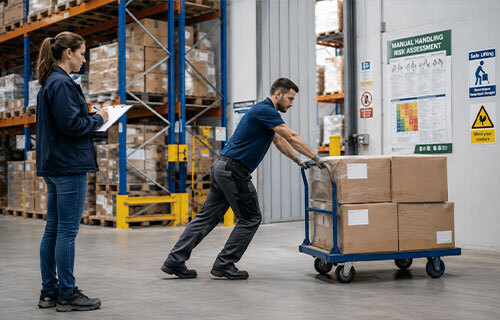
Manual Handling & Lifting Risk Assessments
Manual handling risk is rarely determined by weight alone. The position of the load, the distance from the body, starting and finishing height, frequency, twisting, grip, travel distance, pushing or pulling force and the design of the workplace can all change the physical demand.
Ergo Global assesses manual handling and lifting tasks to identify where risk is being created and what can be changed. Our approach combines observation of real work with appropriate ergonomic assessment methods and practical recommendations.
What Is a Manual Handling Risk Assessment?
A manual handling risk assessment examines how people lift, lower, carry, push, pull, hold or move loads during real work. The objective is to identify the combinations of load, posture, force, repetition, frequency, reach and task design that may increase musculoskeletal risk, then convert those findings into practical changes that can be implemented in the workplace.

Tasks We Can Review
Lifting and Lowering
Carrying
Pushing and Pulling
Repetitive Material Handling
Loading and Unloading
Picking and Packing
Stock Movement
Production Line Handling
Laboratory or Technical Handling Tasks
Team Handling Where Relevant

When a Manual Handling Assessment Is Needed
A manual handling assessment is appropriate where a task involves regular or high-force lifting, repeated movement of stock or equipment, awkward handling postures, frequent carrying, pushing or pulling of trolleys, or complaints of discomfort linked to a physical work task. It is also valuable when a business is changing equipment, introducing a new production process, redesigning a workstation, investigating a pattern of incidents, or validating whether an existing control measure is actually reducing ergonomic exposure.
Typical environments include:
- Manufacturing and assembly operations
- Warehouses, logistics and distribution centres
- Laboratories and technical work areas
- Healthcare, facilities and support operations
- Data centres and equipment-handling environments
- Retail, hospitality and service operations
- Maintenance, engineering and field-service tasks
What We Assess During the Task
The assessment is built around observation of the task as it is actually performed. Depending on the work activity, the ergonomist may review load characteristics, lift origin and destination, working height, horizontal reach, twisting, asymmetry, grip quality, repetition, task duration, recovery time, pushing or pulling force, carrying distance, space constraints and environmental factors.
Where appropriate, recognised ergonomic methods can be used to support professional judgement. These may include the NIOSH Lifting Equation for suitable two-handed lifting tasks, posture-based methods such as RULA or REBA, or other task-specific assessment approaches. The method selected should match the task; no single scoring tool is suitable for every manual handling problem.
Lifting and Lowering
For lifting and lowering tasks, the analysis considers where the load starts and finishes, the distance of the load from the body, vertical travel, asymmetry, frequency and the quality of the hand-to-load coupling. This helps distinguish a task that is acceptable in normal use from one that becomes problematic because of poor layout or repeated exposure.
Pushing and Pulling
For pushing and pulling, the assessment focuses on the force required to initiate and sustain movement, handle height, floor condition, wheel or castor performance, travel distance, turning requirements and the posture adopted by the worker. In many cases, equipment condition or route design is as important as the worker's technique.
The Assessment Process
Understand the task and handling pattern.
Observe representative work and record key task variables.
Identify posture, load, frequency, reach and environmental factors.
Apply the most suitable assessment method or combination of methods.
Prioritise the main drivers of risk.
Develop control options using the hierarchy of controls where practical.
Document recommendations and determine whether reassessment is required.
From Risk Score to Practical Control Measures
NIOSH, REBA and Other Methods
A lifting task may require more than one perspective. The NIOSH method may help quantify lifting demand; REBA may help evaluate whole-body posture; and a broader risk assessment may be needed where the task includes carrying, pushing, pulling or frequent variation.