
Professional RULA Assessments
RULA — Rapid Upper Limb Assessment — is an observational method used to evaluate posture and physical loading in work that places demands on the upper limbs, neck and trunk. It converts observed working positions and task factors into an action-oriented score that helps determine whether further investigation or change is needed.
Ergo Global uses RULA as part of professional ergonomic assessment where the method is appropriate to the task. The purpose is not simply to produce a number. We interpret the score in the context of the actual work, identify what is driving the exposure and recommend practical changes.
Tasks Commonly Suitable for RULA
Bench and Assembly Work
Laboratory and Technical Tasks
Inspection and Quality-Control Activities
Work Involving Tools or Hand-Held Equipment
Seated Industrial or Control-Room Tasks
Repetitive Reaching or Hand-Intensive Work
Maintenance Tasks Performed in Constrained Postures
Computer or Workstation Tasks Where Upper-Body Posture Requires Detailed Review
What a RULA Assessment Measures
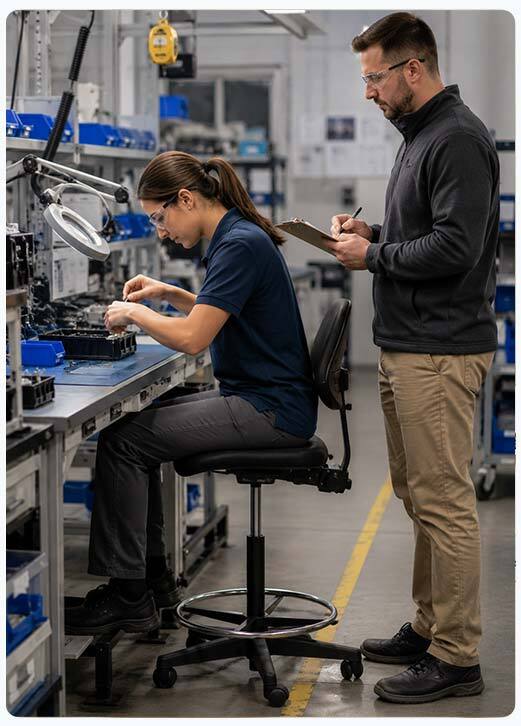
RULA, or Rapid Upper Limb Assessment, is an observational ergonomic method used to evaluate working postures involving the upper arms, lower arms, wrists, neck, trunk and legs. The method also considers muscle use and external load or force. It is particularly useful where a task involves sustained or repeated upper-body postures, constrained work positions or hand-intensive activity.
How a Professional RULA Assessment Is Completed
The assessment begins by understanding the task and selecting the posture or task phase that should be evaluated. This is important because a worker may move through several very different positions during one work cycle. The ergonomist observes the task, records the relevant joint positions and force or muscle-use factors, and calculates the RULA score for the selected exposure.
Where the task varies significantly, more than one posture may be assessed. Video or photographs can support analysis where this is appropriate and authorised. The result is then interpreted in the context of the whole task so that the recommendations address the actual cause of the exposure rather than simply telling the worker to “improve posture”.
Select the Task and Posture
Observe Representative Work Cycles
Record Joint, Force and Muscle-Use Factors
Calculate the RULA Score
Assess Additional Postures Where Needed
Interpret the Score in Task Context
Recommend Controls and Reassess
What the RULA Score Means
RULA produces an action-oriented score that indicates the level of investigation or change that may be required. A higher score suggests that the observed posture and associated task demands warrant more urgent attention. However, the final decision should consider how often the posture occurs, how long it is maintained, the force involved, the worker population and whether other risk factors are present.
Score + Ergonomic Interpretation
The final decision also considers:
RULA, REBA or Another Method?
RULA is particularly focused on upper-limb and upper-body posture. REBA is often more suitable for dynamic whole-body tasks, while manual handling risk assessment methods may be needed where lifting, carrying, pushing or pulling is the main exposure. In complex industrial work, a combined assessment may be more useful than relying on one tool. Ergo Global selects the method according to the task rather than forcing every job into the same scoring system.
RULA as Part of a Wider Ergonomic Risk Assessment
A RULA score does not replace professional judgement or a broader assessment of the work. Force, repetition, task duration, work organisation, equipment and employee feedback may all be relevant. Where the concern extends beyond posture, we incorporate RULA into a wider ergonomic risk assessment.
Typical Improvements Identified Through RULA
RULA frequently highlights problems created by working height, reach distance, tool position, wrist angle, visual demand or poorly positioned components. Depending on the task, controls may include adjusting bench height, repositioning frequently used items, changing tool selection, improving fixture design, reducing overhead reach, modifying seating or standing support, or altering the sequence of the work.
The most effective recommendation is normally the one that changes the task so a better posture occurs naturally. Behavioural reminders can support a good design, but they should not be used as a substitute for correcting a workstation or process that repeatedly forces an awkward posture.
Learn How RULA Works
For teams that want the educational detail behind the method, Ergo Global’s knowledge article explains what RULA is and how the scoring system works.
RULA Assessment Deliverables
Task and posture description
RULA scoring for relevant postures
Photographic or annotated evidence where permitted
Interpretation of the score in the context of the work cycle
Identification of the main posture and task-design risk drivers
Practical engineering, workstation or process recommendations
Prioritised actions and follow-up assessment where required
Arrange a RULA Assessment
Frequently Asked Questions
Is RULA only for office work?
No. RULA is widely useful for industrial, laboratory, technical and assembly tasks where upper-body posture is a significant part of the exposure.
Can RULA be completed from a photograph?
A photograph can support posture scoring, but a professional assessment should understand the real task, frequency, force, duration and work cycle rather than relying on one isolated image.
Does a high RULA score mean an employee will be injured?
No. RULA is a risk-screening and assessment method, not a prediction of injury. A high score indicates that the task should be investigated and controls considered.
Should we use RULA or REBA?
The choice depends on the task. RULA is often better for upper-limb and constrained postures; REBA is commonly used for more dynamic whole-body work. Some tasks benefit from both.