
Industrial Ergonomics Services
Industrial work places unique physical demands on employees — from lifting and carrying to repetitive movement, awkward posture and prolonged standing.
Ergo Global helps organisations identify ergonomic risks, prioritise practical improvements and create safer, more efficient industrial workplaces.

What We Assess
An industrial ergonomics review looks at the relationship between the worker, the task, the equipment and the environment. Depending on the project, this may include:
- Awkward or sustained working postures
- Manual lifting, lowering, carrying, pushing and pulling
- Workstation, bench, machine and tool height or reach
- Material flow and placement of frequently handled items
- Previous discomfort, injury patterns or problem tasks
- Repetitive upper-limb or whole-body movement
- Forceful exertions and grip demands
- Task frequency, duration and recovery time
- Fatigue associated with prolonged standing or static work
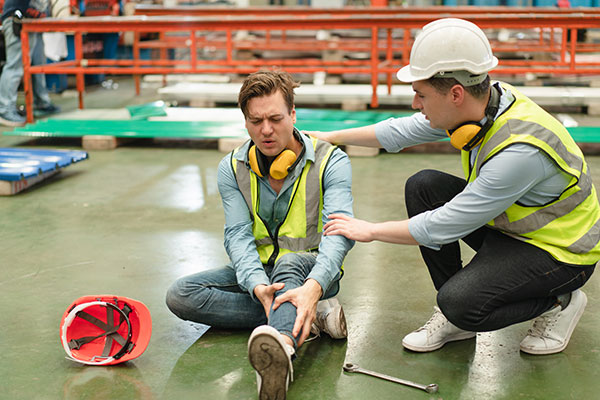
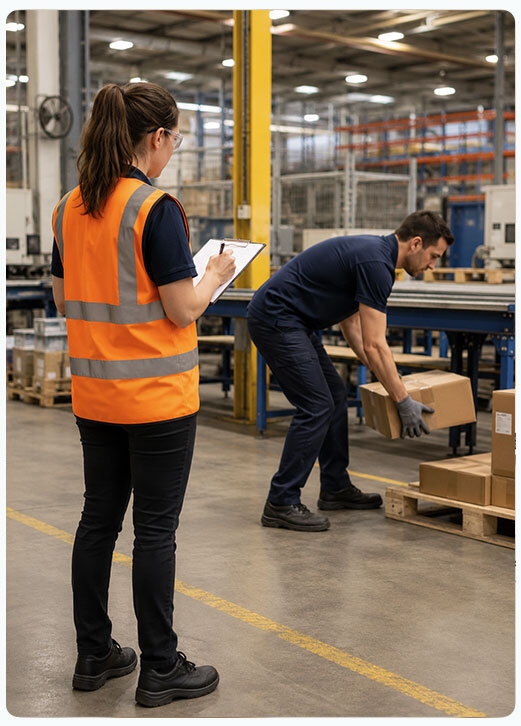
Ergonomic Risk Assessments
Ergonomic Audits
For organisations that need a broader view, an ergonomic audit looks beyond a single worker or workstation. It can cover a production area, warehouse, laboratory, department or entire facility and helps management decide where detailed assessment and intervention should be prioritised. Ergonomic audits
How does an industrial audit help?
An industrial ergonomic audit helps organisations identify and prioritise ergonomic risks across multiple tasks, departments or work areas. It provides a broader view of workplace risk and helps determine where detailed assessments such as RULA, REBA, manual handling or posture analysis are required.
RULA and REBA Assessments
Posture-scoring methods can be useful when work involves sustained or repeated body positions. RULA is particularly useful for upper-limb, neck and trunk exposure, while REBA is designed for whole-body postural analysis and is often suited to dynamic or variable tasks. We use the method that fits the task rather than forcing every job into a single scoring tool.
RULA assessment servicesREBA assessment services
Manual Handling and Lifting Risk
Lifting and material handling cannot be reduced to a single weight limit. Frequency, load position, travel distance, asymmetry, coupling, floor height, reach and task design all influence risk. Where appropriate, our ergonomists can use recognised manual-handling and lifting assessment approaches, including the NIOSH Lifting Equation, alongside professional observation.
Manual handling and lifting risk assessmentsPosture and Task Analysis
Some problems are not primarily about lifting. A worker may be reaching into a machine, holding the neck in rotation, working with the hands above shoulder level, standing in one position for long periods or repeating a fine-motor task hundreds of times. Posture and task analysis helps identify these exposures and the changes most likely to reduce them.
Ergonomic posture and task analysisFrom Findings to Practical Change
A useful ergonomics project should end with decisions, not just scores.
Our recommendations can cover equipment, workstation dimensions, material location, work sequence, mechanical assistance, task rotation, training, work-rest patterns or further specialist assessment.
We prioritise recommendations so teams can distinguish urgent corrective action from medium-term improvement.
For larger organisations, assessments can also sit inside a wider
ergonomics programme that combines assessment, training, employee engagement, reporting and follow-up across multiple sites.
Explore our specialist Data Centre Ergonomics services for technology environments, server areas and control rooms.


Proof / Case Study
Abbott Singapore – Laboratory Ergonomics
In 2021, Abbott engaged Ergo Global to help address
musculoskeletal disorders (MSDs) and staff-reported bodily discomfort within its Singapore laboratory. Ergo Global carried out a full analysis of the facility and its staff, including process analysis, employee surveys and employee observations.
9 processes analysed
900 employees assessed
Singapore Laboratory View Case Study
Industrial Ergonomics Across Our Key Markets
Ergo Global supports organisations across multiple countries and can align a common ergonomics approach with local workplace requirements and operating conditions. Explore our industrial ergonomics services in:
Who This Service Is For
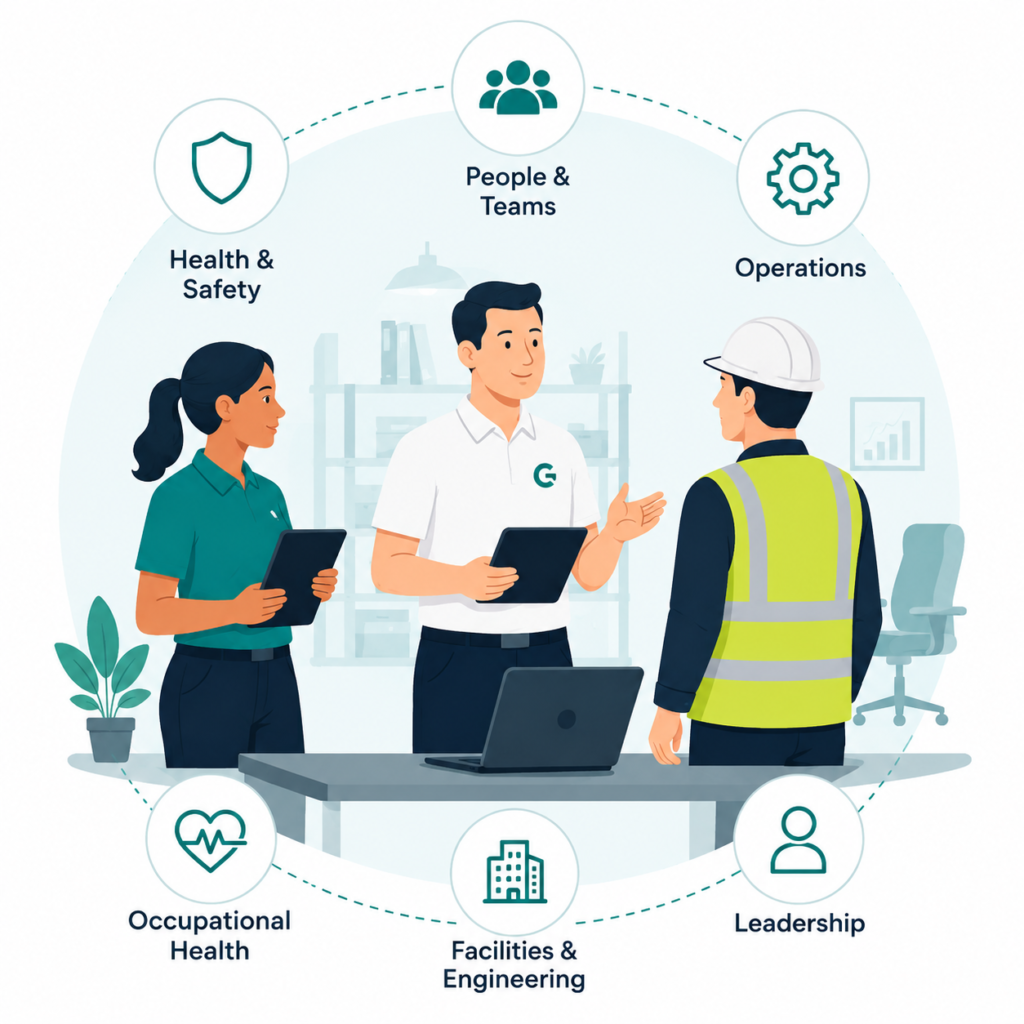
Industrial ergonomics is relevant wherever physical work, task design or equipment interaction may contribute to discomfort, fatigue, reduced efficiency or musculoskeletal risk. Typical project sponsors include health and safety teams, EHS leaders, operations managers, occupational health teams, HR, facilities, engineering and site leadership.
When to Use an Industrial Ergonomics Programme vs a Single Assessment
A focused ergonomic assessment is usually the right choice when a specific task, workstation or known problem has already been identified. It allows the ergonomist to examine the relevant exposure in detail, understand the factors contributing to the risk and recommend practical improvements for that particular activity.
A broader industrial ergonomics programme or ergonomic audit is more appropriate when an organisation needs to identify and prioritise risks across several departments, work areas or sites. This approach can also be useful where there are recurring musculoskeletal concerns, a new facility or process is being designed, or a consistent framework is needed to compare and prioritise ergonomic risks across multiple operations.
The programme can help determine which issues can be addressed through practical workplace improvements and which tasks require more detailed assessments such as RULA, REBA, manual handling assessment or posture and task analysis. This gives organisations a practical basis for deciding where immediate action is needed and where deeper task-specific assessment will provide the greatest value.
Talk to Ergo Global
If you have a high-risk task, a recurring discomfort issue, a new production process or a facility-wide concern, we can help define the right assessment approach. Tell us what your team does, where the work is performed and what problem you are trying to solve, and we will scope the next step.