
Industrial Ergonomics Services in Malaysia
Ergo Global provides industrial ergonomics services in Malaysia for organisations managing manufacturing, logistics, technical and other physically demanding work.
Our work focuses on non-office and physically demanding tasks: manual handling, lifting, repetitive activity, awkward posture, force, static loading, workstation or equipment layout and the interaction between people and the process. We can support a single problem task or a wider programme across departments and sites.
Industrial Ergonomic Risk Assessments
Where a task, role or process has already been identified as a concern, we carry out a focused ergonomic risk assessment. The assessment looks at how the work is actually performed, identifies the main physical risk factors and develops practical controls.
Ergonomic Audits
For facilities with several areas or uncertainty about where to start, an ergonomic audit creates a broader view. It identifies high-priority tasks, recurring exposures and areas that need more detailed assessment.
RULA & REBA Assessments
Where posture-scoring methods are appropriate, our ergonomists can use RULA for upper-limb, neck and trunk exposure and REBA for whole-body, dynamic tasks. The method is chosen to fit the work.
Manual Handling & Lifting Risk
We assess lifting, lowering, carrying, pushing, pulling and repetitive material handling. The review looks at task geometry, frequency, force, load position, coupling and opportunities to redesign or mechanise the work. The NIOSH Lifting Equation may be used where appropriate.
Posture & Task Analysis
For work dominated by awkward, repetitive or static postures, task analysis identifies why the worker is adopting the position and what changes to height, reach, layout, tools or process are likely to improve it.
Industrial Ergonomics & Malaysian Ergonomics Risk Guidance
Malaysia’s Department of Occupational Safety and Health publishes specific guidance on ergonomics risk assessment and manual handling. This gives employers a clear local framework for identifying ergonomic hazards and managing physically demanding work.
The guidance supports a systematic approach to identifying, assessing and controlling ergonomic risk factors. In practice, this means reviewing how tasks are performed, identifying the physical demands that contribute to risk, prioritising the most significant concerns and selecting practical controls that fit the work environment.
For organisations operating in manufacturing, electronics, warehousing and logistics, laboratories, healthcare and other technical or shared industrial environments, ergonomic assessment can help translate these principles into task-specific improvements. The assessment approach should remain practical and evidence-led, while recognising that local requirements and operating conditions may vary between workplaces.
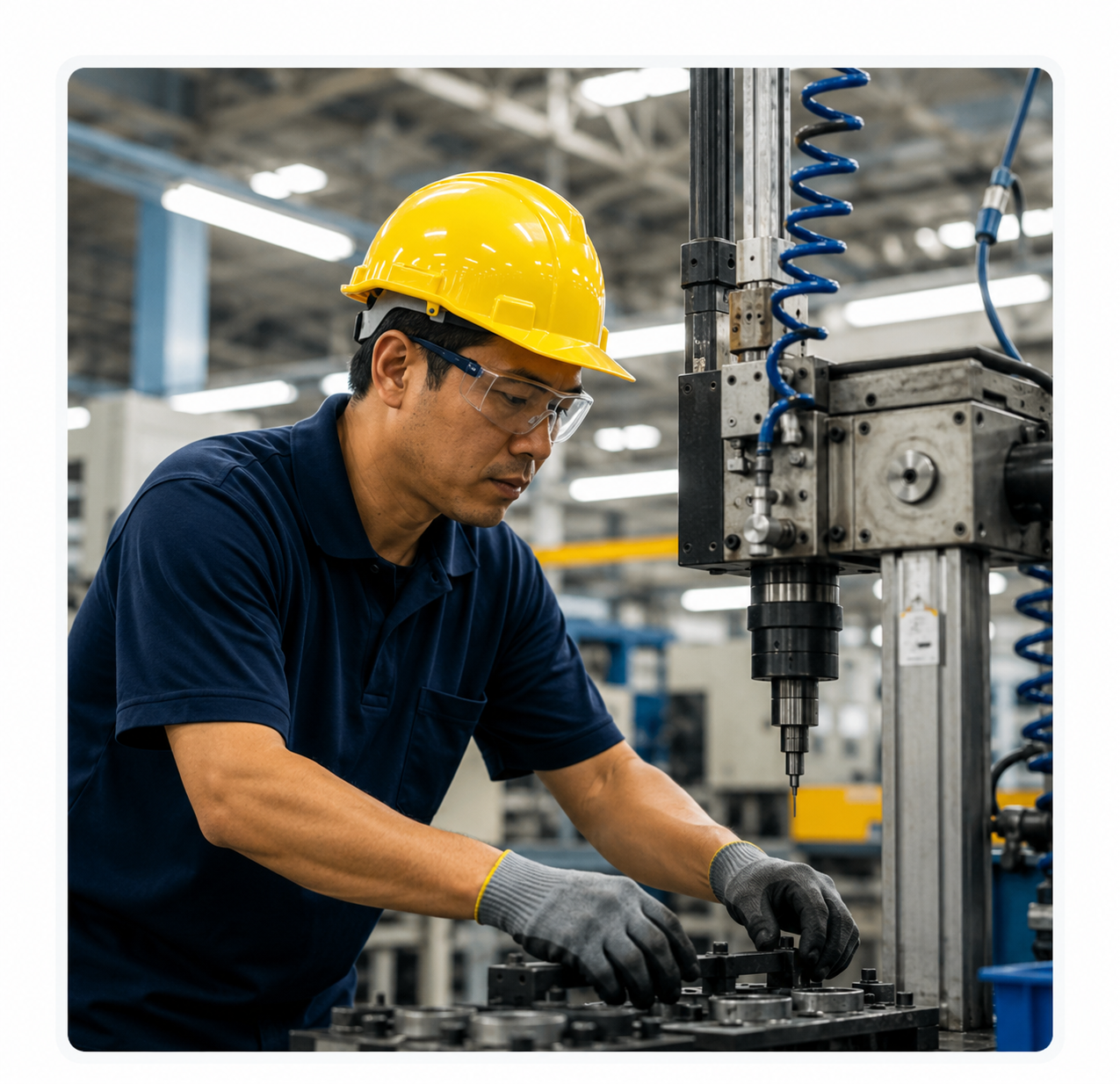
Industries We Can Support in Malaysia
Manufacturing and production
Warehousing and logistics
Electronics and technical operations
Laboratories and research
Healthcare
Facilities and maintenance

A Practical, Evidence-Led Approach
Our recommendations are designed to be usable by operations and safety teams. Rather than treating assessment scores as the final output, we identify the physical drivers of risk and translate them into prioritised actions. Depending on the project, this can include engineering changes, layout changes, mechanical assistance, work-method improvements, training or follow-up assessment.
Multi-Site & Regional Programmes
For organisations operating across several locations, Ergo Global can coordinate a common industrial ergonomics framework while allowing for local work practices, regulatory requirements and site conditions. This provides a consistent way to identify risk and track improvement without turning every site into a separate one-off project.
What to Expect
Tell us the site, task and concern.
We scope the appropriate level of review.
An ergonomist observes and assesses the work.
You receive prioritised findings and practical recommendations.
Where required, we support implementation, training or reassessment.
Arrange an Industrial Ergonomics Assessment in Malaysia
If you have a specific task, a recurring discomfort issue, an upcoming process change or a facility-wide concern, contact Ergo Global with a short description of the work and location. We will help define the right assessment approach.