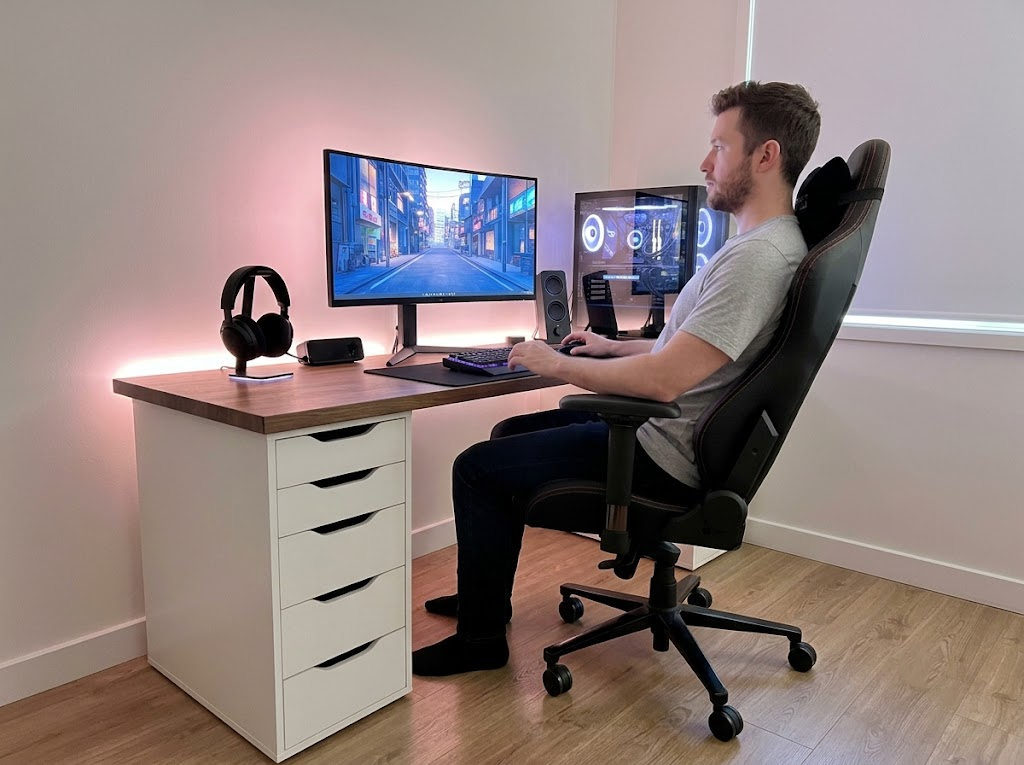


Your head weighs 10 to 12 pounds when it sits balanced over your spine. Drop it forward to read a phone or hunch toward a monitor, and the load on your neck climbs fast.
At 15 degrees of forward tilt, the Cleveland Clinic reports the strain jumps to around 27 pounds, and at 60 degrees it reaches roughly 60 pounds. Hold that position for hours a day, week after week, and the muscles adapt in ways that hurt.
That slow adaptation is what people mean by tech neck. The right tech neck exercises can undo a good part of it by loosening the shortened muscles and rebuilding the weakened ones.
What Tech Neck Actually Does to Your Body
Tech neck refers to the forward-head posture that develops from long hours spent on phones, laptops, and monitors. The head drifts ahead of the shoulders, the chin pokes out, and the upper back rounds to compensate. Over time, this becomes your default resting state, and the discomfort that follows can feel like it appeared out of nowhere.

Underneath the posture sits a predictable pattern of muscle change. Some muscles get chronically short and tight while their opposites get long and weak, and that imbalance keeps pulling your head back into the wrong spot.
The muscle imbalance behind forward head posture
Three groups do most of the damage when your head lives out in front of your shoulders:
- Tight and overworked in front: the chest muscles pull your shoulders forward and inward, locking in the rounded look.
- Tight and overworked on top: the upper trapezius and levator scapulae, which run from your neck to your shoulder blades, stay clenched all day, holding your head up.
- Weak and lengthened in front of the neck: the deep cervical flexors, the small muscles that should keep your head stacked over your spine, switch off and lose strength.
Fixing tech neck means treating all three at once. You stretch what has tightened and strengthen what has faded, then repeat often enough that the new position becomes normal.
Warning signs you already have it

Most people notice tech neck symptoms long before they see it in a mirror. Common early signals include:
- A dull ache at the base of the skull that gets worse the longer you sit
- Tight, tender shoulders and a knot where the neck meets the traps
- Tension headaches that build through the afternoon
- Reduced range of motion when you try to turn or tip your head
- A visible bump forming at the base of the neck over time
>>> Read more: 5 Signs You’re a Victim of Bad Desk Ergonomics
Why Stretching Alone Falls Short
The instinct when your neck aches is to stretch the back of it, since that is where the tightness sits. That instinct only solves half the problem.
According to a physical therapist quoted by Popular Science, the muscles at the back of your neck are already overstretched from looking down, so pulling on them further can make the ache worse.
Lasting relief comes from a two-part approach. You release the muscles that have shortened across your chest and along the sides of your neck, and you build strength in the deep neck muscles and the upper back so they can hold your head upright without help. Here is the split at a glance:
| Muscle group | Its state in tech neck | What it needs |
| Chest (pectorals) | Short and tight | Stretch |
| Upper trapezius and levator scapulae | Short and tight | Stretch |
| Deep cervical flexors | Long and weak | Strengthen |
| Mid and lower trapezius, rhomboids | Long and weak | Strengthen |
| Thoracic spine | Stiff and rounded | Mobilize |
The seven exercises below cover every row in that table, so nothing gets left behind.
The 7 Tech Neck Exercises to Reverse Forward Head Posture
This routine works both sides of the imbalance at once. Three moves lengthen the chest and neck muscles that have tightened, three rebuild the neck and upper-back muscles that have weakened, and one frees the stiff mid-back that lets your head slide forward.
1. Chin Tuck
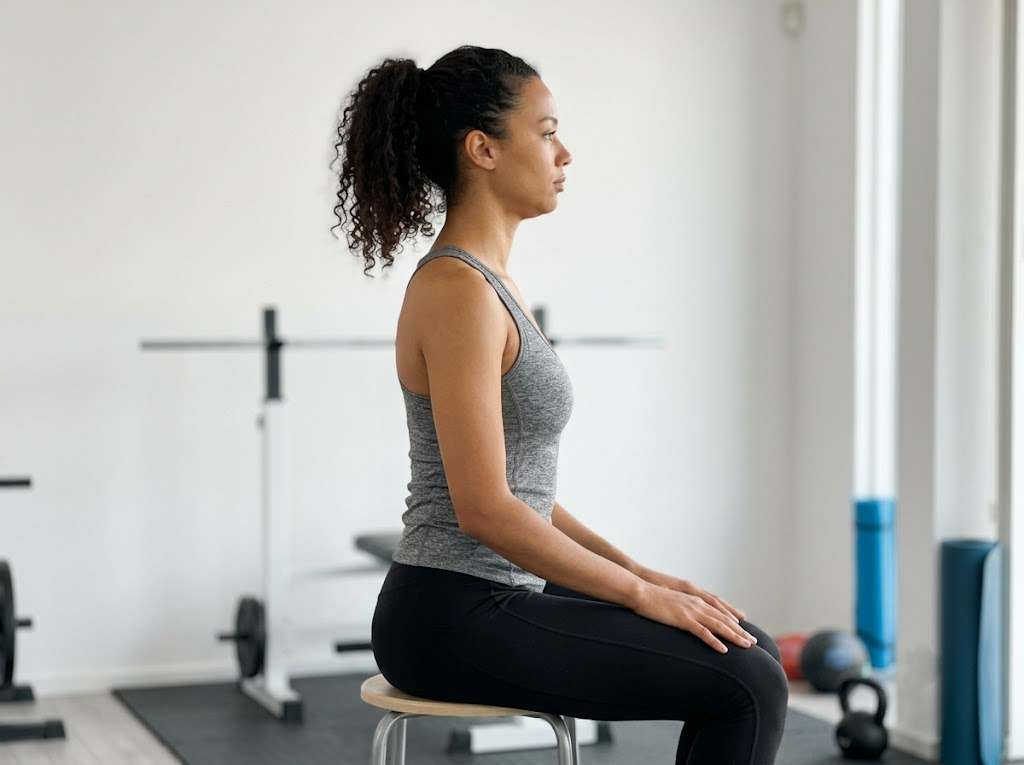
What it does: Rebuilds the deep cervical flexors, the small front-of-neck muscles that hold your head over your spine. Looking down all day switches them off, so your head drifts forward, and the back of your neck overworks to keep it up. Each tuck trains your head back into place and eases the base of your skull.
How to do the chin tuck:
- Sit or stand tall, shoulders relaxed, eyes forward.
- Keeping your face level, glide your head straight back to make a light double chin.
- Stop at a gentle stretch under the base of your skull.
- Hold for 5 seconds, then release slowly.
Reps: 10, once or twice a day. Easy to repeat at your desk.
2. Doorway Pectoral Stretch
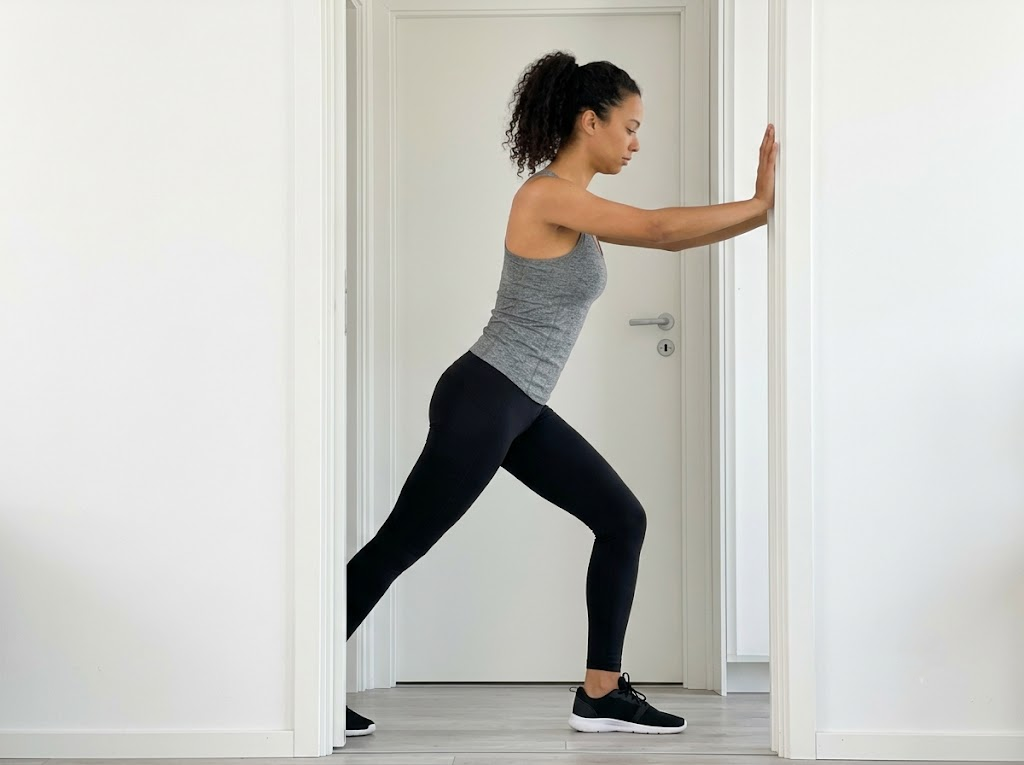
What it does: Opens the chest muscles that round your shoulders forward. When the pecs shorten, they roll your shoulders inward and push your head forward. Loosening them lets your shoulder blades settle back so your head can stack upright.
How to do the doorway pectoral stretch:
- Stand in a doorway with your forearms flat on the frame, elbows near shoulder height.
- Step one foot through into a short lunge.
- Lean your weight forward until you feel a stretch across your chest and the front of your shoulders.
- Keep your ribs down and lower back neutral so the stretch stays in the chest.
Hold: 20 to 30 seconds, 2 to 3 times.
3. Upper Trapezius Stretch

What it does: Lengthens the upper trapezius, the muscle from the base of your skull to the top of your shoulder that stays switched on all day to hold a forward head up. That steady load sits behind a lot of tight shoulders and afternoon tension headaches. Releasing it calms the pull on your skull and drops your shoulders.
How to do the upper trapezius stretch:
- Sit tall and tuck your right hand under your thigh to anchor your shoulder.
- Tilt your left ear slowly toward your left shoulder until the right side of your neck stretches.
- For more, rest your left hand on the side of your head and let its weight do the work.
- Keep both shoulders level.
Hold: 20 to 30 seconds on each side.
4. Levator Scapulae Stretch

What it does: Targets the levator scapulae, which runs from your upper neck to the inner corner of your shoulder blade and is often where stubborn knots form. It pulls at a different angle than the upper trapezius, so it needs its own stretch. Freeing it restores rotation and calms the sore spot where neck meets shoulder.
How to do the levator scapulae stretch:
- Sit tall and anchor your right hand under your thigh.
- Turn your head about 45 degrees left, as if looking toward your armpit.
- Drop your chin toward that armpit until the back-right side of your neck stretches.
- Rest your left hand on the back of your head for a little more reach.
Hold: 20 to 30 seconds on each side.
5. Scapular Squeeze

What it does: Switches the mid and lower trapezius and the rhomboids back on. These muscles between and below your shoulder blades pull your shoulders back and down, and they fade as your posture rounds forward. Strong again, they hold your shoulders in place through the day.
How to do the scapular squeeze:
- Sit or stand tall, arms relaxed at your sides.
- Draw both shoulder blades back and down, as if pinching a pencil between them.
- Keep your shoulders away from your ears and your chin lightly tucked.
- Hold for 5 seconds, then release slowly.
Reps: 10. A good micro-break between emails.
6. Wall Angels
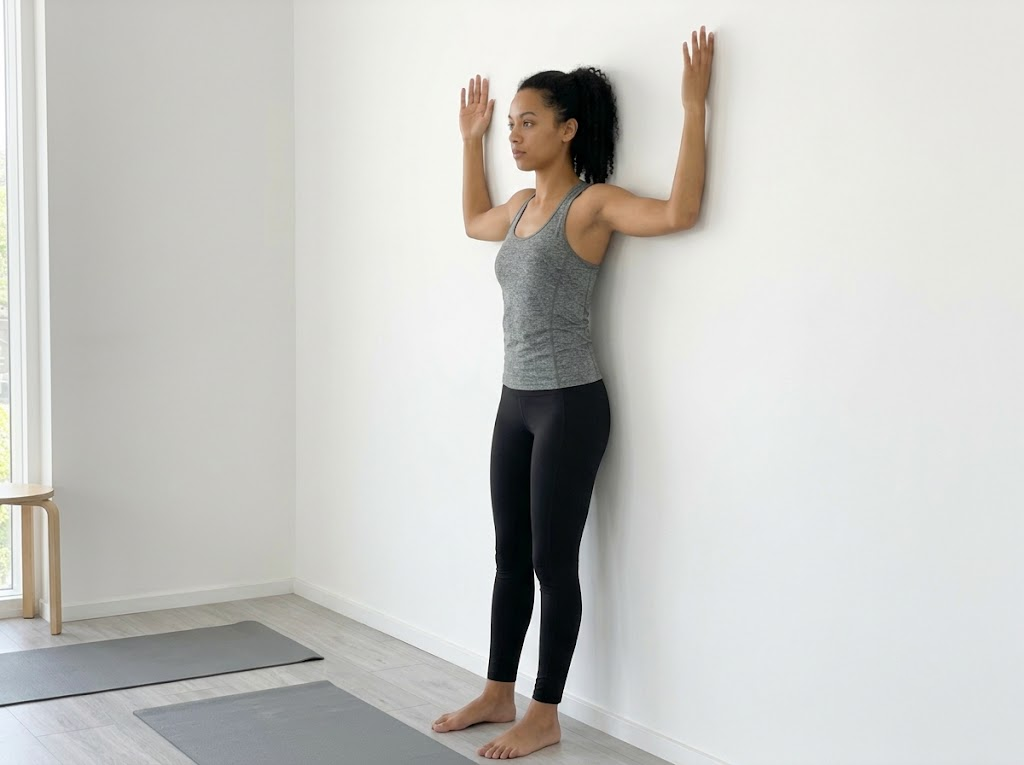
What it does: Teaches your shoulder blades to glide while your spine stays long, building control through the upper back. The wall gives you constant feedback, so you feel the exact point where your posture wants to collapse and can catch it as you move.
How to do wall angels:
- Stand with your back to a wall, feet a few inches out.
- Press your lower back, upper back, and the back of your head lightly to the wall.
- Raise your arms into a goalpost shape, with the backs of your hands and your elbows on the wall.
- Slide your arms overhead as far as they will go while keeping contact, then lower them back down.
Reps: 10 slow reps. Keep your ribs down so your lower back stays flat to the wall.
7. Thoracic Extension Over a Chair
What it does: Frees the mid-back. When the thoracic spine stiffens into a rounded shape from long sitting, your head has nowhere to go but forward, and your neck compensates. Restoring the extension here takes that load off your neck and often provides the fastest relief in the whole routine.
How to do the thoracic extension:
- Sit in a firm chair whose backrest meets the bottom of your shoulder blades.
- Lace your hands behind your head, elbows pointing forward.
- Keeping your lower ribs down, arch your upper back gently over the top edge of the chair.
- Go only as far as feels comfortable, then return upright.
Reps: 8-10 slow reps. Move only through the upper back, and keep the range small.
How Often to Do These Tech Neck Exercises
Consistency matters more than intensity with posture work. The muscles you are retraining need frequent, gentle reminders rather than occasional hard sessions. A practical target is the full routine three to five times a week, with the two stretches you feel most tightly done daily.
Progress usually follows a familiar timeline. Most people notice less stiffness and easier movement within two to four weeks of regular practice. More visible changes in head and shoulder position tend to appear around the six- to eight-week mark. The pattern took years to build, so allow your body reasonable time to unwind it.
You do not need to set aside a dedicated block either. Chin tucks and scapular retractions work well as micro-breaks at your desk, and the stretches slot neatly into a pause between meetings. Spreading small doses of movement through the day often beats a single long session.
>>> Read more: Ergonomics for Computer Users: How to Prevent Work Pains
Ergonomic Habits That Support the Exercises
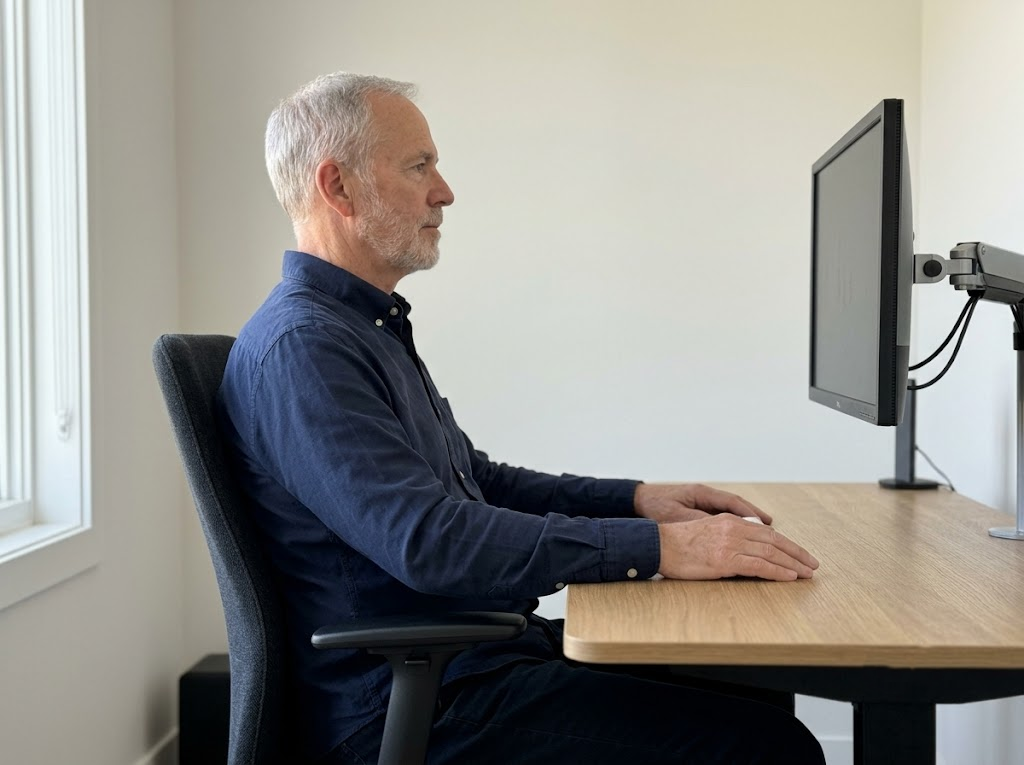
Exercise corrects the muscle imbalance, and your workstation decides how quickly it returns. If your setup keeps forcing your head forward for eight hours, even a diligent routine struggles to keep up. A few adjustments protect the progress you make on the mat.
- Raise your screen. Position the top of your monitor at or just below eye level, about an arm’s length away, so you look forward rather than down.
- Use a laptop stand. Pair it with an external keyboard and mouse to lift the screen without cramping your arms.
- Take movement breaks. A common recommendation is a five-minute break every hour or a fifteen-minute break every two hours. Stand, walk, and reset your posture.
- Switch to a headset. For phone-heavy roles, a headset keeps your neck aligned instead of cradling a handset against your shoulder.
- Vary your position. A sit-stand desk lets you alternate between sitting and standing, which reduces the strain of holding any single posture too long.
These habits reinforce every exercise in this guide. They keep your head balanced during the hours you are not actively stretching, when most of the daily load actually accumulates.
>>> Read more: How to Set Up the Best Ergonomic Desk Position
When to See a Professional
Most cases of tech neck respond well to exercise and better workstation habits. Some symptoms call for medical attention rather than self-care. See a healthcare provider if you experience:
- Severe or worsening pain despite regular stretching
- Numbness, tingling, or weakness in your arms or hands
- Pain that radiates down the arm or into the fingers
- Symptoms that persist beyond a few weeks of consistent effort
A physical therapist can assess your specific imbalance and tailor a program to it, and an ergonomics assessment can pinpoint the workstation factors feeding the problem in the first place.
How We Can Help at Ergo Global

At Ergo Global, we help individuals and organizations solve tech neck problems at its source. Exercises relieve strain, and a workstation built around the person helps prevent it from returning.
Our team runs comprehensive ergonomics assessments, delivers employee training workshops, and designs setups that keep your people comfortable, healthy, and productive through long screen hours. We pair practical fixes with a self-assessment platform that makes ergonomics measurable across your whole workforce, so improvements are easy to track and sustain.
If neck and shoulder strain is affecting your team, we would love to help you build a workplace that supports better posture every day.
Ready to protect your team from tech neck? Talk to our ergonomics consultants and start building a healthier, more productive workspace.