

A REBA assessment is a pen-and-paper method for measuring the strain a work task places on the whole body, from the trunk and legs to the arms and wrists. REBA stands for Rapid Entire Body Assessment, and it turns a worker’s posture into a single number from 1 to 15 that tells you how urgently a task needs fixing.
Ergonomists reach for it when a job involves lifting, bending, carrying, or awkward full-body positions, and it sits alongside RULA as one of the two most widely used posture-scoring tools in the field.
What Is a REBA Assessment?
The Rapid Entire Body Assessment (REBA) is an observational ergonomic tool used to evaluate a worker’s risk of developing musculoskeletal disorders (MSDs). While other assessments focus strictly on desk work or arm movements, REBA was specifically designed for unpredictable, full-body tasks, which makes it highly popular in healthcare, construction, and manufacturing.

Where the method comes from
Sue Hignett and Lynn McAtamney developed REBA and published it in the journal Applied Ergonomics in 2000. They built it as a field tool sensitive to the unpredictable, changing postures found in healthcare and service work, where earlier upper-limb tools fell short. The tool has since spread well beyond hospitals into manufacturing, construction, warehousing, and agriculture.
What REBA measures
A REBA assessment divides the body into two posture groups, then layers three task factors on top. Each part contributes to the final score:
- Group A (trunk, neck, legs). Each segment earns a base score from its angle. The trunk and neck are scored by how far they flex or extend, plus a point for twisting or side bending. The legs are scored for balanced versus unstable weight, with an adjustment for deep knee flexion, as shown in Table A.
- Group B (upper arms, lower arms, wrists). Scored the same way for both sides. The upper arm reflects its angle relative to the body, with points for a raised shoulder, abduction, or rotation, and a reduction when supported. The lower arm and wrist are scored by their own angles, as shown in Table B.
- Load or force. How much weight the worker handles. Under 11 pounds adds nothing, 11 to 22 pounds adds one point, and heavier adds two points, with an extra point for shock or a rapid buildup of force.
- Coupling. The quality of the handgrip, scored from good (no points) to unacceptable (3).
- Activity. How the task plays out over time, adding points for static holds over a minute, small repeated actions, and rapid or unstable movements.
Those pieces combine, through the scoring tables, into a final number from 1 to 15 that reflects the overall musculoskeletal risk of the task.
>>> Read more: How to Perform an Ergonomics Assessment
How to Score a REBA Assessment
The scoring follows a fixed sequence. You build two subtotals, combine them, add an activity factor, then map the result to a risk level. Each step below shows what to record and how it rolls up. A fuller walkthrough of the Table A, B, and C mechanics is worth keeping open the first few times you run one.
Before you score: capture the right posture
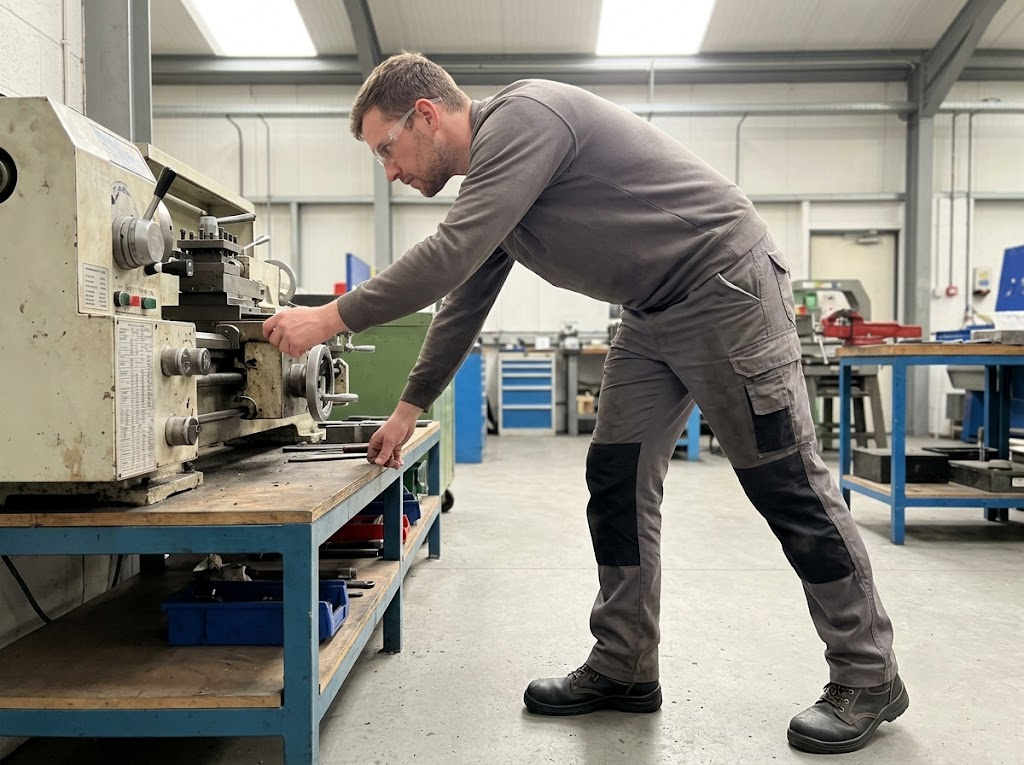
The score is only as good as the posture you measure, so take a moment to set up. Interview the worker to understand the task, then watch a few full work cycles, ideally on video, so you can pause on the angles that matter. From that footage, pick the postures worth scoring, usually the most awkward and the most frequently repeated positions rather than one convenient frame.
A single job often requires more than one assessment, since the strain during a lift differs from that during a reach.
Step 1: Score Group A (trunk, neck, legs)
Start with the trunk, giving it a base score for how far it flexes forward or extends back, then add a point if it twists or side bends. Do the same for the neck. For the legs, score whether the worker’s weight is supported evenly on both feet or held in an unstable position, then add for deep knee flexion.
Feed the three numbers into Table A to get a subtotal, then add the load score.
A load under 11 pounds adds nothing; 11 to 22 pounds adds one point; and anything heavier adds two, with an extra point for shock or a rapid buildup of force.
The result is Score A.
Step 2: Score Group B (upper arms, lower arms, wrists)
Score the upper arm for its angle relative to the body, adding points for abduction, a raised shoulder, or rotation, and subtracting 1 point if the arm is supported or the person leans on something. Score the lower arm for its flexion angle, then the wrist for how far it bends or twists from the midline.
Run those through Table B for a subtotal, then add the coupling score for grip quality. A good grip adds nothing; a fair grip adds one; a poor grip adds two; and an unacceptable grip adds three.
That gives you Score B.
Step 3: Combine the scores and add activity
Take Score A and Score B into Table C, which returns a combined figure called Score C. The last piece is the activity score, which reflects how the task plays out over time.
Add one point each when a body part is held static for longer than a minute, when a small-range action repeats more than four times a minute, and when the posture changes rapidly, or the base is unstable.
Add the activity score to Score C to obtain the final REBA score.
Step 4: Read the final REBA score
The final number lands somewhere between 1 and 15, and each band maps to a risk level and an action level. This table shows how to read it:
| REBA score | Risk level | Action level | What it means |
| 1 | Negligible | 0 | No action needed |
| 2 to 3 | Low | 1 | Change may be needed |
| 4 to 7 | Medium | 2 | Action needed |
| 8 to 10 | High | 3 | Action needed soon |
| 11 to 15 | Very high | 4 | Action needed now |
A medium score is common in everyday work and flags a task worth investigating. Studies that ground these risk bands in real workplaces show that scores cluster by job type. The whole flow condenses to five moves:
- Score the trunk, neck, and legs, then add load to get Score A.
- Score the upper arms, lower arms, and wrists, then add coupling to get Score B.
- Combine A and B in Table C to get Score C.
- Add the activity score for the final REBA score.
- Match that number to its risk and action level.
>>> Read more: A Guide to Workplace Ergonomic Assessments
When to Use REBA Instead of RULA
REBA and RULA come from the same research family, so the choice between them trips up a lot of people. It comes down to which part of the body carries the risk. Match the tool to the task and the score will tell you something useful.

What RULA does differently
RULA stands for Rapid Upper Limb Assessment. McAtamney and Corlett published it in 1993, seven years before REBA, and built it for display-screen and manufacturing work. It scores the neck, trunk, and arms in fine detail and produces a grand score from 1 to 7. Because it zooms in on the upper body, RULA reads seated and repetitive tasks like typing, assembly, microscope work, or dentistry more sharply than a whole-body tool would.
A simple rule for choosing
Use REBA when the whole body is loaded. Think lifting, carrying, pushing, patient handling, working in cramped or constrained positions, or any job where the legs, trunk, and arms all take strain.
Reach for RULA when the upper limbs drive the risk, and the lower body stays mostly still. RULA gave a more protective reading for upper-limb tasks, so a whole-body tool can dilute the arm-and-wrist detail on sedentary jobs.
| Factor | REBA | RULA |
| Full name | Rapid Entire Body Assessment | Rapid Upper Limb Assessment |
| Body coverage | Trunk, neck, legs, arms, wrists | Neck, trunk, arms, wrists |
| Score range | 1 to 15 | 1 to 7 |
| Best for | Lifting, carrying, patient handling, dynamic full-body work | Typing, assembly, microscope, seated repetitive tasks |
| Also factors in | Load, coupling, activity | Muscle use and force |
| Published | Hignett and McAtamney, 2000 | McAtamney and Corlett, 1993 |
When to run both

Plenty of jobs contain both kinds of work. A garment worker might haul heavy fabric rolls one moment and run a sewing machine the next. In cases like that, running a REBA assessment on the lifting task and a RULA on the seated task gives you a clearer map of where the risk actually lives. There is no rule against using both tools on the same person at different times of day.
>>> Read more: What Are the Principles of Ergonomics?
Strengths and Limitations of REBA
Every screening tool has a sweet spot and a blind spot, and REBA is no exception. REBA is best viewed as a frontline screening tool rather than a comprehensive diagnostic instrument. It is highly effective at quickly identifying severe postural risks, but complex tasks often require it to be paired with tools that measure cumulative daily strain.
Where REBA is strong
- Comprehensive Body Coverage: It evaluates the entire body simultaneously. By accounting for the neck, trunk, legs, and upper limbs, it captures the physical reality of dynamic jobs in which workers bend, reach, and shift their weight.
- Low Barrier to Entry: It requires zero specialized equipment, wearable sensors, or software. An evaluator only needs a clipboard, the REBA worksheet, and direct observation (or video footage) to conduct an assessment.
- Considers Contextual Variables: Posture is only part of the equation. REBA also adjusts the final score based on the load handled, the worker’s ability to grip the object (coupling), and whether the movement is static, repetitive, or involves rapid changes in force.
- Highly Actionable Output: The assessment produces a single final risk score (ranging from 1 to 15) that corresponds to five clear Action Levels. This gives safety professionals a concrete metric to justify immediate interventions to management.
What to watch for
- Single-Posture Focus: REBA evaluates a specific “snapshot” in time — typically the worst-case posture or the one held the longest. It struggles to accurately reflect continuous, highly variable tasks where a worker is constantly moving through different planes of motion.
- Observer Subjectivity: Because it relies on the human eye to estimate exact joint angles (e.g., deciding if a trunk is bent exactly 20 degrees), it suffers from inter-rater reliability issues. Two different evaluators might score the exact same movement slightly differently.
- Poor Measurement of Cumulative Duration: While it includes a basic activity score for static postures held for more than 1 minute, it does not effectively measure total daily exposure. A worker holding an awkward posture for 30 minutes versus 6 hours will yield the same REBA score, even though the long-term risk of injury differs greatly.
- Blind to External Risk Factors: It measures pure biomechanical strain but completely ignores other well-documented ergonomic risk factors, such as hand-arm vibration, extreme temperatures, or psychosocial stress.
>>> Read more: How Ergonomics Improves Health and Safety in the Workplace
Put a REBA Assessment to Work With Us

At Ergo Global, we help organizations turn posture scores into real reductions in injury and lost time. Running a REBA assessment is one piece of a larger program, and we handle the whole program.
Our certified ergonomists assess your tasks with the right tool for each job, whether that is REBA, RULA, or another validated method, then translate the results into practical fixes your team can act on. We have helped more than half a million employees across over 100 companies work in greater comfort, and we would be glad to do the same for yours.
Want to know where your workplace stands? Reach out to us for an ergonomic assessment, and we will help you identify and address the tasks that pose the greatest risk.