

Workplace injuries tied to poor ergonomics cost businesses billions of dollars each year. According to WorkCare, musculoskeletal disorders are responsible for over 1 million workplace injuries annually in the U.S. alone, costing employers an estimated $20 billion in workers’ compensation claims.
For companies managing teams across multiple offices, countries, or remote setups, keeping track of who has been assessed, what risks exist, and whether the business meets local safety regulations is nearly impossible to do manually. That is where ergonomics compliance software comes in.
What Is Ergonomics Compliance Software?
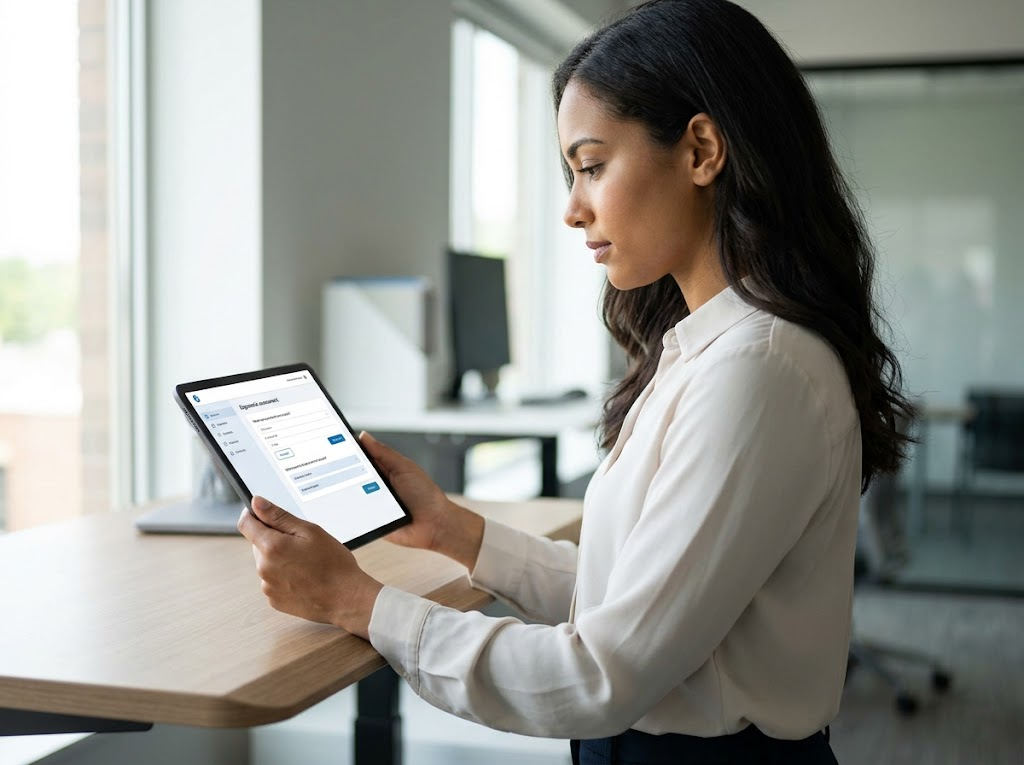
Ergonomics compliance software is a digital platform that helps businesses assess, manage, and document the ergonomic health of their workforce. It replaces spreadsheets, paper forms, and one-off assessments with a centralized system that handles everything from risk scoring to regulatory reporting.
The goal is straightforward. It gives companies a structured, scalable way to identify ergonomic risks, take action to resolve them, and maintain a clear record that proves they are meeting their legal obligations.
Most modern platforms are cloud-based. Employees can complete assessments from any device, and managers can track results, flag high-risk cases, and generate compliance reports from a single dashboard.
Many also include built-in educational content to help employees take ownership of their ergonomic health over time.
What Does Ergonomics Compliance Software Actually Do?
Ergonomics compliance software automates the process of identifying who is at risk, what needs to change, and whether the right actions have been taken. It turns a reactive, paper-based process into a continuous, data-driven program.
The most effective platforms follow a structured workflow that mirrors how a professional ergonomics program operates:
- Assess each employee’s workspace through guided or AI-powered evaluations
- Score risk and flag individuals most likely to develop musculoskeletal disorders
- Escalate high-risk cases to a qualified ergonomist automatically
- Recommend equipment and workstation adjustments tailored to each person
- Educate employees with videos, tips, and quizzes for lasting habit change
- Track every assessment, action, and outcome in one auditable record
- Report across teams, regions, and departments for management visibility
This creates a continuous prevention loop rather than a reactive scramble after an injury claim. The strongest platforms also integrate with existing HR and EHS systems, so ergonomic data becomes part of the broader picture of workplace health.
Why Businesses Are Turning to Ergonomics Compliance Software
For decades, many companies treated ergonomics as a one-time checkbox during onboarding. That approach is no longer sustainable.
The Shift to Hybrid and Remote Work

With employees spread across home offices, coworking spaces, and satellite locations, companies no longer have direct visibility into how their people are working.
According to the National Spine Health Foundation, approximately 35% of U.S. employees now work remotely full-time. A centralized software platform gives employers that visibility without requiring an ergonomist to visit every location.
A Growing Regulatory Landscape
Workplace health and safety laws around the world are becoming more specific about ergonomic obligations.
In the EU, the Display Screen Equipment (DSE) regulations require employers to assess and reduce risks for workers who use screens regularly. In the US, OSHA guidelines hold employers responsible for providing workstations that do not cause harm. Standards such as ISO 45001 further formalize the expectation that companies proactively manage occupational health risks.
The Financial Cost of Inaction

Musculoskeletal disorders remain the single largest category of workplace injuries. According to the Business Group on Health, MSK conditions account for 19% of all health care visits, and the combined cost of treatment and lost wages totals $980 billion per year in the United States.
The direct cost of a single MSD-related injury can range from $15,000 to $85,000 per case. Indirect costs, such as lost productivity and retraining, can double or triple that amount.
Investing in ergonomics compliance software is far less expensive than dealing with the fallout of preventable injuries. When you factor in reduced absenteeism, lower insurance premiums, and improved productivity, the return on investment becomes clear quickly.
Does Your Business Need Ergonomics Compliance Software?
Not every company needs a full enterprise platform, but the need grows quickly with team size, location complexity, and regulatory exposure.
A team of five people in a single office can likely manage ergonomics with basic training and periodic check-ins. But once your workforce reaches the dozens or hundreds, especially across different locations or countries, the manual approach breaks down quickly.
Here are some signs that your business is ready for one.
- You have remote or hybrid employees and cannot assess their setups at scale.
- You operate globally and must comply with different local compliance laws.
- Your human resources and safety teams waste hours on manual paperwork.
- You see rising musculoskeletal complaints and injury-related absences.
- You lack audit-ready documentation for inspections or insurance reviews.
- You only address physical risks after an injury actually happens.
- Your employees receive new equipment but get no ongoing training on proper posture.
- You buy expensive ergonomic furniture without tracking its actual impact.
- Your company is growing fast, and manual safety tracking simply cannot keep up.
If any of these apply to you, ergonomics compliance software is not just a convenience. It is a risk management tool that protects your people and your bottom line.
What to Look for When Choosing a Platform
Not all ergonomics compliance software is built the same. When evaluating options, focus on the features that match your actual needs.
AI-Powered Assessments
Static questionnaires deliver the same generic advice to everyone. AI-powered assessments adapt in real time based on each employee’s responses, delivering personalized guidance that is faster and more effective.
Scalability
Your platform should support your team at its current size and grow with you. Look for solutions that work for teams of 10 just as well as teams of 10,000 or more.
Multi-Language and Multi-Region Support
If you have employees in more than one country, you need a platform that supports multiple languages and maps its assessments to the specific compliance laws in each region.
Built-In Education
The best ergonomics compliance software does not stop at assessment. It continues with videos, tips, and quizzes that help employees build lasting habits and self-correct over time.
Reporting Dashboards
Managers need real-time visibility into risk trends, completion rates, and program performance. Clear dashboards make it easy to spot issues early and demonstrate compliance during audits.
Ergonomist Access
Automated tools handle the majority of cases, but complex or high-risk situations still benefit from a trained ergonomist’s judgment. The best platforms connect employees directly to qualified professionals when needed.
ErgoWOW: Ergonomics Compliance Software Built by Ergonomists
One platform that brings all of these capabilities together is ErgoWOW, developed by Ergo Global. ErgoWOW is an AI-powered ergonomics compliance software platform designed for teams of 80 to 80,000 and used by companies across 55+ countries.
Key features include:
- AI-guided self-assessments with personalized health scoring
- Automated escalation to qualified ergonomists for high-risk cases
- Tailored equipment and workstation recommendations
- Educational videos, infographics, and quizzes
- Real-time dashboards by geography, department, or health category
- Compliance tracking for ISO 45001, OSHA, and EU DSE
- 20+ languages across 50+ countries
- API integration with SAP, Workday, and SSO for enterprise
- Web-based access on any device with no downloads required
- White-labeling and branded assessment experiences
How ErgoWOW Works
The platform follows three steps. First, each employee completes a guided self-assessment powered by trained AI, which generates a personal ergonomic health score. If risks are flagged, the employee is referred to a qualified ergonomist for a virtual one-on-one session.
Second, employees receive tailored equipment and adjustment recommendations based on their results.
Third, the platform delivers ongoing education through videos, infographics, and quizzes to build long-term healthy habits across the organization.
Compliance and Reporting
For management, ErgoWOW provides real-time reporting dashboards with insights broken down by geography, department, or health category.
Compliance tracking adapts to the specific laws that affect your business. Whether you are subject to EU DSE rules, OSHA guidelines, or ISO 45001, the platform has you covered. Integration with systems like SAP and Workday ensures ergonomic data flows into your broader HR and safety workflows.
Built by Ergonomists, Not Just Engineers
What makes ErgoWOW different is that it was built by practicing ergonomists. Every assessment pathway, recommendation, and escalation rule is grounded in clinical ergonomic expertise.
The platform is customizable to your company’s policies, brandable with your identity, and designed to scale without losing the personal touch that makes ergonomic interventions effective.
Employees can complete their self-assessment in under 10 minutes using plain language and visuals, so no prior ergonomic knowledge is needed. For companies that want to start small, ErgoWOW supports teams as few as 10 and scales seamlessly as the organization grows.
Let Ergo Global Help You Stay Compliant and Keep Your Team Healthy
At Ergo Global, we have conducted over 550,000 ergonomic assessments across 55+ countries with a team of 80+ qualified ergonomists. We understand that compliance is not just about checking a box. It is about building a culture where every employee is supported, educated, and set up to work without pain.
Whether you need a platform to manage assessments at scale or expert consultants to guide your program from the ground up, we have the tools and the team to help.
Ready to see what ErgoWOW can do for your organization?
Request a free demo from a senior ergonomist today.