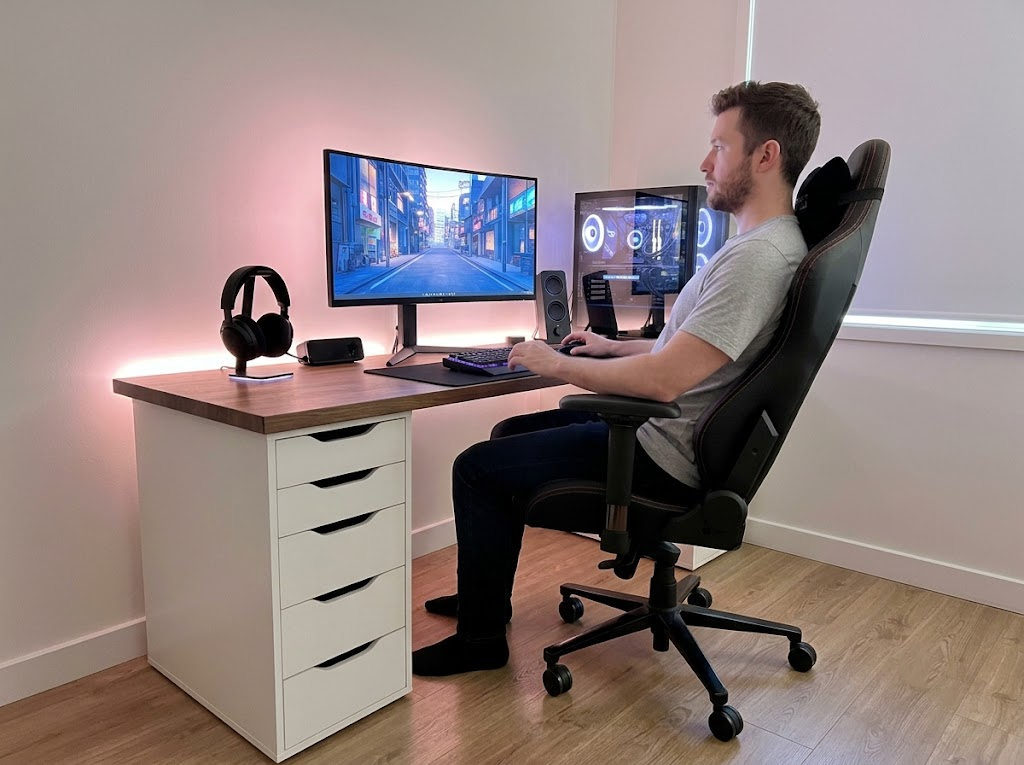


By the time a workers’ compensation claim lands on your desk, the damage is already done. An employee is injured, productivity has stalled, and your business is facing costs ranging from tens of thousands to hundreds of thousands of dollars. The good news is that most claims tied to musculoskeletal disorders have a long lead-up time, during which signs of an ergonomic hazard are clearly visible to anyone who knows what to look for.
This guide is for safety managers, HR professionals, and business owners who want to get ahead of the problem. Proactive identification of an ergonomic hazard is one of the most effective investments you can make for your workforce and your organization’s financial health.
The True Cost of an Undetected Ergonomic Hazard
Understanding what is at stake is the right place to start. According to the U.S. Bureau of Labor Statistics, musculoskeletal disorders are responsible for over one million workplace injuries every year, costing employers an estimated $20 billion in workers’ compensation claims. The direct cost of a single MSD-related injury can range from $15,000 to $85,000 per case. Indirect costs from lost productivity, retraining, and administrative work can double or triple that figure.
The National Safety Council’s 2024 data puts the total cost of work injuries at $181.4 billion, which includes wage and productivity losses, medical expenses, and administrative overhead. The average cost of a single medically consulted workplace injury sits at $48,000.
These are real numbers with real consequences for organizations of all sizes, and what makes them particularly difficult to accept is that the majority are preventable. OSHA reports that structured ergonomics programs can reduce injuries by up to 60%, and for every dollar invested in workplace safety, businesses see an average return of 57.3%.
The math favors action. The question is where to start.
What Qualifies as an Ergonomic Hazard?

An ergonomic hazard is any aspect of a job, workspace, or work process that creates a mismatch between the physical demands placed on a worker and that worker’s physical capabilities. Over time, this mismatch causes strain on muscles, tendons, nerves, and joints, and can progress to injury if left unaddressed.
OSHA identifies five primary ergonomic risk factors present across virtually every industry:
Force
Tasks requiring significant physical effort, including heavy lifting, pushing, pulling, or carrying. Higher force demands accelerate wear on the musculoskeletal system, particularly in the lower back, shoulders, and wrists.
Repetition
Performing the same motion throughout a workday without adequate variation or rest. Assembly-line operations, data entry, scanning, and packaging carry a high risk of repetition. Repetition amplifies the damage caused by every other risk factor.
Awkward Posture
Working in positions that place the body out of its neutral alignment. Reaching above shoulder height, bending at the waist repeatedly, and twisting the torso while handling materials are among the most common examples.
Contact Stress
Sustained localized pressure on a specific part of the body, such as resting the wrist against a sharp desk edge during typing, or pressing the palm against a hard tool grip across an entire shift.
Vibration
Whole-body vibration from vehicles or heavy machinery, and hand-arm vibration from power tools, can cause progressive nerve and circulatory damage over time, even in workers who appear otherwise healthy.
The Behavioral Clues That Reveal an Ergonomic Hazard
OSHA explicitly identifies worker behavior as one of the most reliable early signals of an ergonomic problem. When you walk the floor with the right eyes, you will start to see patterns that point directly to the hazards.
Shaking Out Hands and Rolling Shoulders

A worker who frequently shakes out their hands, flexes their fingers, or rolls their shoulders mid-task is not stretching for fun. They are responding to discomfort. Shaking out the hands typically indicates that the tissues in the wrist, forearm, or fingers are under sufficient strain that the worker needs to interrupt the task to relieve the sensation, whether numbness, tingling, aching, or loss of grip strength.
OSHA’s ergonomic guidance specifically flags these behaviors as indicators that workers may be experiencing MSD risk factors. Rolling shoulders signal tension in the upper trapezius and neck, which is common among workers who spend extended periods with arms elevated, reaching forward, or maintaining a static head-forward posture.
When you see these behaviors regularly, and across more than one worker at a particular station or on a particular task, the issue is almost certainly the job design, not the individual.
DIY Tool and Workstation Modifications
This is one of the most telling signals in any workplace, and one of the most commonly overlooked. When a worker wraps a tool handle with duct tape or foam padding, attaches a makeshift wrist rest to their workstation, props their monitor on a stack of boxes, or improvises a footrest from a spare crate, they are solving a real physical problem with whatever is available.
Workers rarely modify their tools or environment out of habit or preference. They do it because something about the original setup is causing enough discomfort that they have decided to address it themselves. According to OSHA’s hazard identification resources, employees modifying their tools and equipment is a direct behavioral indicator that ergonomic risk factors are present and should be investigated.
These DIY fixes often point to specific hazards: a handle that requires too much grip force, a work surface at the wrong height, a poorly positioned screen, or a task that forces a sustained awkward wrist position. What the worker has identified by feel, a trained assessor can then measure and correct properly.
Frequent Painkiller Use at Work
A bottle of ibuprofen on a desk, a worker who heads to the first aid cabinet regularly for pain relief, or a team where over-the-counter anti-inflammatories are a running conversation topic, these are signals worth paying attention to.
Workers managing low-level chronic pain from an ergonomic hazard often reach for pain relief as a way to keep working through symptoms. This behavior typically appears well before a formal medical visit. It represents a worker who is coping with a condition rather than reporting it, often because the pain feels manageable in the short term.
Painkiller use at work as a normalized pattern points strongly to a job or workstation that is producing ongoing musculoskeletal strain. It also suggests that reporting culture may need attention alongside the physical hazard.
Wearing Personal Braces or Supports
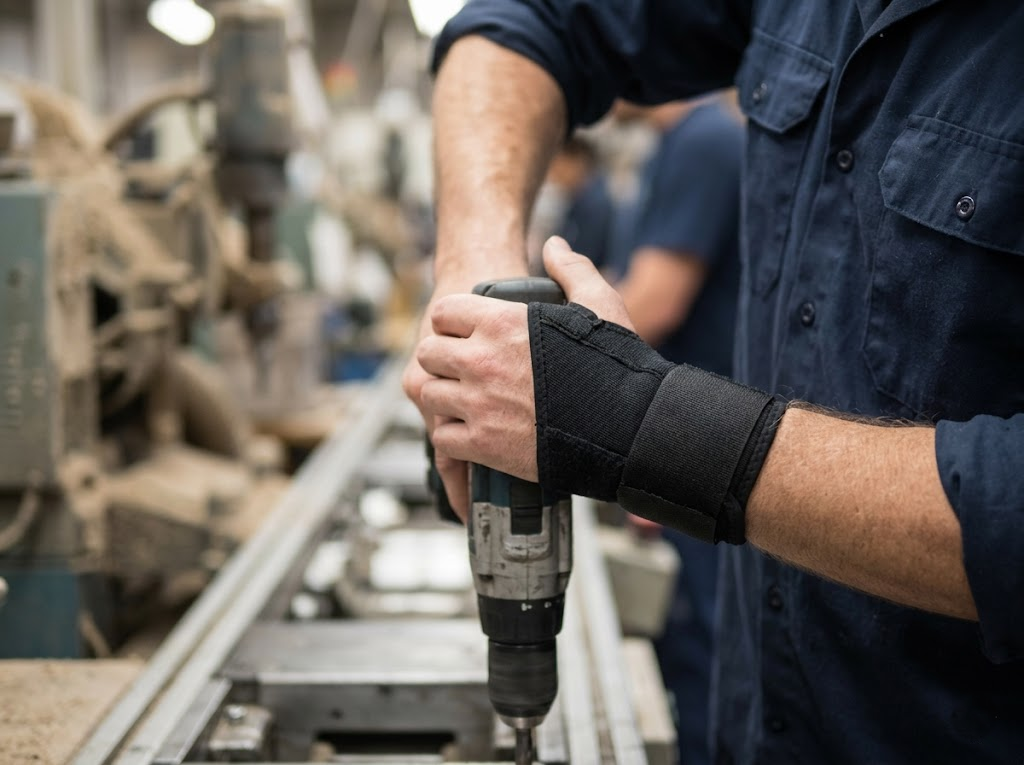
Training resources aligned with OSHA’s guidance recommend watching for workers who bring wrist braces, back belts, or other personal supports to work. This is another clear self-management signal. A worker who has independently sourced and started wearing a wrist splint or compression sleeve has typically reached that point because their symptoms have been persistent enough to warrant it.
This does not mean the brace is fixing the problem. Bracing can provide some symptom relief, but it does not address the underlying ergonomic hazard. The hazard persists, and the worker continues to absorb the load. What the brace tells you is that the problem has been present long enough for the worker to seek out their own solution.
Avoiding Certain Tasks or Positions
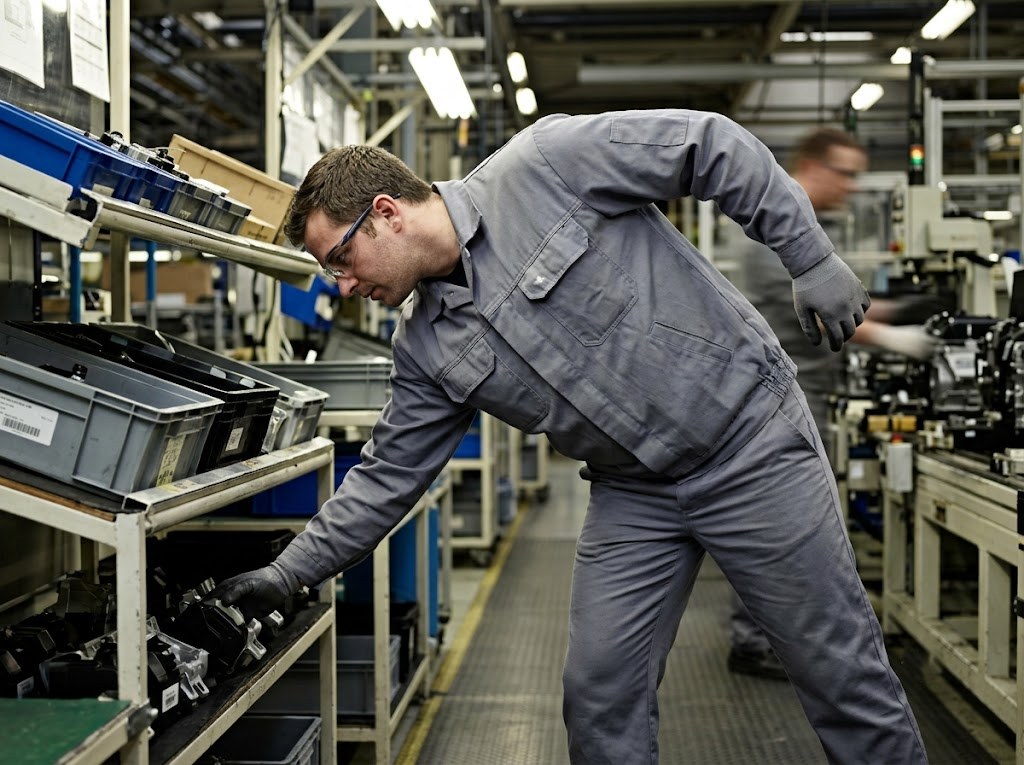
Watch for workers who consistently find reasons to hand off particular tasks, who shift their bodies in unusual ways during certain motions, or who take noticeably longer on steps of a job that their colleagues move through quickly. These patterns often reflect pain avoidance. The worker has learned that a specific motion or posture reliably causes discomfort and is unconsciously restructuring their work to reduce exposure to it.
This kind of behavioral adaptation can also introduce new ergonomic hazards by pushing strain to other joints and muscle groups as the body compensates.
Physical Workspace Red Flags to Look For
Behavioral signs are almost always accompanied by identifiable conditions in the physical environment. During your next walkthrough, give particular attention to the following:
- Workstation setup that doesn’t fit the person: Monitors too high or too low, keyboards forcing the wrist into an unnatural angle, and chairs that can’t accommodate different body types.
- Tools that weren’t designed with comfort in mind: Hard, narrow handles demanding a tight pinch grip, equipment that vibrates more than necessary, or tools heavier than the task requires.
- Hard floors with nothing underfoot: Concrete surfaces in areas where people stand for long periods, without anti-fatigue matting to absorb the load on joints and feet.
- Materials stored at the wrong height: Boxes kept at floor level or above shoulder height force workers into extreme positions every time they reach for something.
- Workspaces that are too tight to move well in: When there isn’t enough room to position the body comfortably, workers compensate with whatever posture fits the space, and those compensations add up over time.
A structured ergonomic assessment checklist helps you move through a workspace methodically and catch hazards that a casual walkthrough overlooks.
Practical Framework for Proactive Ergonomic Hazard Identification

Building a proactive process means making ergonomic hazard identification a regular part of how your organization operates, woven into your safety culture rather than reserved for annual audits.
- Start with direct conversations – The workers performing the tasks every day have the most direct experience of where discomfort occurs. Ask them specifically. Build a reporting channel that feels supportive so workers feel comfortable raising concerns early, before they become injuries.
- Observe work under real conditions – Watch how employees actually perform their tasks during production, particularly during high-demand periods. The difference between how tasks should be performed in theory and how they are performed under production pressure is precisely where many ergonomic hazards become apparent.
- Review injury and absence records for patterns – Recurring sprains, strains, and repetitive-use injuries are reliable indicators of an ongoing ergonomic hazard that has yet to be resolved. Look across roles, departments, shifts, and seasons to find where the problems concentrate.
- Use a standardized scoring tool – Ergo Global’s OSHA ergonomics checklist guide walks you through the risk-scoring process step by step and helps you prioritize high-risk areas before they generate claims.
- Engage a professional ergonomist – For workplaces with complex physical demands, recurring MSD injuries, or high workforce turnover, an experienced specialist identifies hazards that internal reviews routinely miss and recommends controls matched to your specific workflows and budget.
Why Acting Early Pays Off Financially
Proactive ergonomics programs deliver a return on investment that frequently ranges from 6 to 10 times the initial cost. For every dollar spent addressing an ergonomic hazard before it results in an injury, organizations recover between six and ten dollars through avoided claims, reduced absenteeism, and improved productivity.
Companies that invest in workplace safety improvements can reduce their overall injury-related costs by up to 40%. The longer an ergonomic hazard goes unaddressed, the more that cost compounds, and the harder it becomes to reverse the impact on both workers and your organization’s workers’ comp experience rating.
The behavioral clues are there. The financial case is clear. The window for proactive action is open, but it closes the moment an injury occurs.
We’re Here Whenever You’re Ready to Take That Next Step
At Ergo Global, we work with organizations across industries to identify ergonomic hazards before they lead to injuries or workers’ comp claims. Our experienced ergonomists bring together technical expertise and real-world practical understanding to every engagement, from individual workstation assessments to full-scale programs tailored to your workforce and workflows.
We partner closely with your safety and HR teams throughout the process, focusing on building your internal capacity so the improvements we make together continue long after we leave. Our approach is straightforward: we identify the hazards, explain what they mean in plain language, and help you implement solutions that are realistic for your team and budget.
Whether you are already seeing early warning signs or simply want to get ahead of things before they start, we’d genuinely love to help you build a workplace that takes good care of the people in it.
Ready to take the first step? Reach out to us at Ergo Global, and let’s talk about how proactive ergonomics consulting can benefit your team.