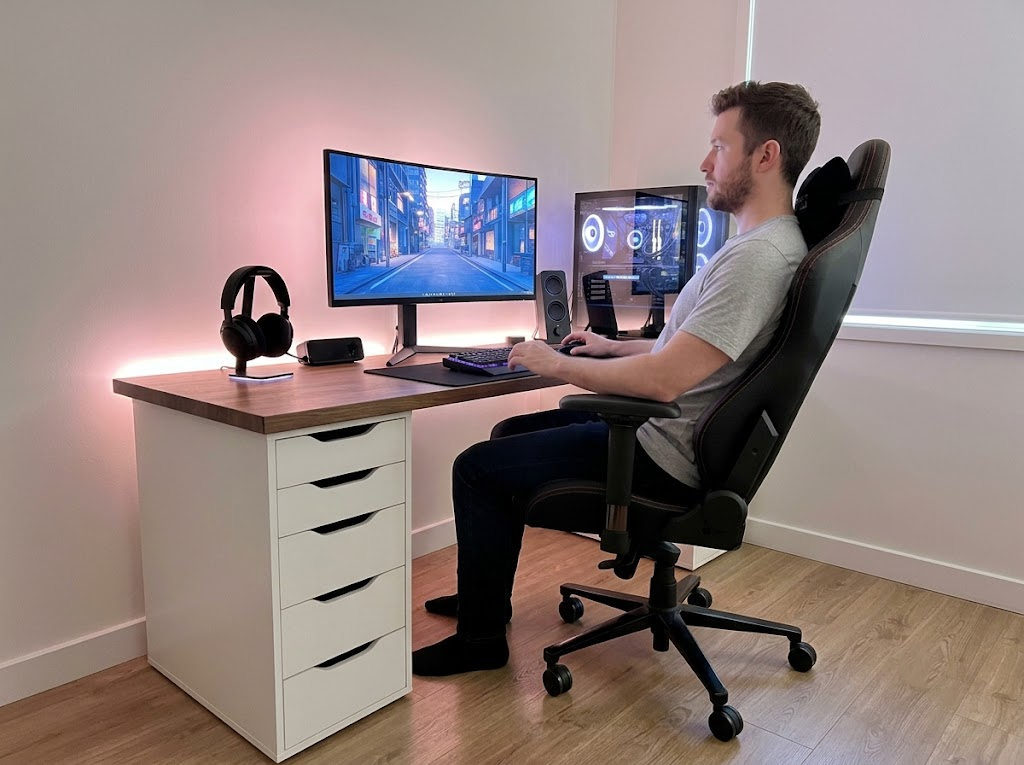


If you have ever wondered whether a workstation is quietly straining the people who use it, RULA is one of the most practical ways to find out. So what is RULA? A RULA assessment is a fast, structured method for measuring the postural strain a job places on a worker’s neck, trunk, and upper limbs, and it turns that strain into a single score that indicates how urgently something needs to change.
What Is RULA?
RULA stands for Rapid Upper Limb Assessment. It is a postural analysis tool developed in 1993 by Dr Lynn McAtamney and Professor E. Nigel Corlett, ergonomists at the University of Nottingham, to estimate the risk of work-related upper limb disorders. The method has since become one of the most widely used ergonomic screening tools worldwide.
At its core, RULA is a screening method that looks at biomechanical and postural loading on the upper body, with particular attention to the neck, trunk, and arms. An assessor observes a worker, records the angles of individual body segments, and notes the amount of force involved and how often the movement repeats. The further a posture deviates from neutral, the higher the score for that body part.
The whole process fits on a single worksheet and produces a grand score from 1 to 7. A low score means the posture is acceptable, and a high score signals an immediate need for change. Because it is quick to complete and requires no expensive equipment, RULA works well as an early screening step within a broader ergonomics review.
>>> Read more: A Guide to Workplace Ergonomic Assessments
What Does a RULA Assessment Measure?
RULA evaluates three things together: posture, muscle use, and force. Posture carries most of the weight in the final score, and the muscle use and force elements adjust that score to reflect how demanding the task really is. To keep the analysis organized, the body is split into two scoring groups.
Group A: Arm and Wrist Analysis

Group A focuses exclusively on the upper extremities. The evaluator measures the exact angles of the arms and wrists to assign initial scores.
- Upper Arms: The ideal posture keeps the upper arm close to the body with minimal flexion. Evaluators assign a score of 1 if the arm remains between 20 degrees of extension and 20 degrees of flexion. The score increases as the angle becomes more extreme. Bending the arm forward beyond 90 degrees earns a maximum posture score of 4. Evaluators award extra points if the worker’s shoulder is raised or the arm is abducted from the body. They subtract a point if the arm receives support from an armrest or work surface.
- Lower Arms: Evaluating the lower arm involves looking at the elbow joint. A comfortable angle between 60 and 100 degrees receives a score of 1. Any angle outside this range receives a score of 2. An additional point applies if the arm crosses the midline of the body or moves outward to the side.
- Wrists: Wrist posture significantly impacts cumulative trauma risks. A neutral wrist receives a score of 1. Mild flexion or extension receives a score of 2. Severe bending of the wrist up or down receives a score of 3. Evaluators add a point if the wrist deviates from side to side.
- Wrist Twist: The rotation of the wrist also plays a role in the equation. A comfortable mid-range twist scores 1. A posture requiring the wrist to twist near the end of its natural range scores 2.
Group B: Neck, Trunk, and Leg Analysis

Group B evaluates the body’s central support structure. These areas dictate overall stability and frequently bear the brunt of poor ergonomic design.
- Neck: A neutral neck position with a slight forward tilt between 0 and 10 degrees receives a score of 1. Bending the neck further forward increases the score. Tilting the head backward into extension automatically receives a score of 4. Evaluators add points if the neck twists to the side or bends laterally.
- Trunk: Trunk posture directly affects spinal health. Sitting or standing completely upright receives a score of 1. Leaning forward increases the score up to a maximum of 4 for extreme bending. Twisting the torso or bending to the side adds additional penalty points.
- Legs: The assessment considers whether the legs provide adequate support. Evaluators assign a score of 1 if the worker’s legs and feet have solid support and bear weight evenly. A posture lacking proper foot support or featuring uneven weight distribution receives a score of 2.
For further insights into maintaining optimal spinal health at your desk, check out the Ergo Global post “Office Posture and Long-Term Health.”
Additional Variables: Muscle Use and Force
Posture alone does not tell the whole story. The frequency of movement and the physical load placed on the body heavily influence injury risk.
- Muscle Use Score: Sustained postures cause muscle fatigue. Evaluators award a point if the worker maintains a static posture for more than 1 minute. They also add a point if the action repeats more than four times per minute.
- Force and Load Score: Handling heavy or awkward items increases physical stress. No load or a load under 4.4 lbs (2 kg) held intermittently adds 0 points. A moderate load held intermittently adds 1 point. A moderate load held statically adds 2 points. Handling heavy loads over 22 lbs (10 kg) or experiencing sudden shocks or jerks adds 3 points.
How a RULA Assessment Works
Calculating the final results involves using a specific set of scoring tables provided by the assessment framework. The process merges the posture scores with the muscle use and force scores to generate an overarching risk level.
Step-by-Step Calculation
The calculation process follows a strict sequence to ensure accuracy across all evaluations. The process is quick once you know the steps, and staying methodical keeps your results reliable and repeatable.
Most practitioners work through six stages:
- Observe the task. Watch several full cycles of the work, ideally on video, to capture posture accurately. A photograph freezes only one moment, while video lets you review borderline positions frame by frame.
- Select the posture to score. Choose the worst-case posture or the one held the longest. Decide whether to assess the left side, the right side, or both, since RULA scores each side separately.
- Score Group A. Rate the upper arm, forearm, wrist, and wrist twist, then read the combined posture score from Table A.
- Score Group B. Rate the neck, trunk, and legs, then read the combined posture score from Table B.
- Add muscle use and force. Apply the muscle-use and force points to each group. Group A becomes Score C, and Group B becomes Score D.
- Find the grand score and action level. Combine Score C and Score D through the final table to produce a grand score from 1 to 7, then read its action level.
The whole cycle can take under ten minutes per posture once you are familiar with the worksheet. Complex jobs with several distinct postures may call for more than one assessment.
>>> Read more: 7 Steps for Conducting an Ergonomics Assessment
Interpreting the Final Score
The final number corresponds to a specific Action Level. This tiered system helps safety managers prioritize their interventions and allocate resources effectively.
Each score band maps to an action level that tells you what to do next.
| Grand score | Action level | What it means |
| 1 to 2 | Action level 1 | Posture is acceptable if it is not maintained or repeated for long periods |
| 3 to 4 | Action level 2 | Further investigation is needed, and changes may be required |
| 5 to 6 | Action level 3 | Investigate and make changes soon |
| 7 | Action level 4 | Investigate and change immediately to prevent injury |
One point is worth keeping in mind when you read a result. The grand score is a relative measure of risk rather than an absolute one, so it is most useful for comparing scores. Running a RULA assessment before and after a change, such as raising a monitor or adding a document holder, shows in plain numbers whether the intervention actually reduced the strain.
When to Use RULA, and When to Reach for Another Tool
RULA is a specialist tool with a clear sweet spot.
Knowing where it performs well, and where its focus becomes a limitation, helps you apply it to the right jobs and pair it with other methods when needed.

Where RULA fits best
RULA was built for tasks that load the upper body while the worker stays largely in one place. That makes it well suited to a specific set of situations:
- Computer and desk workstations
- Precision assembly and light manufacturing
- Laboratory and inspection work
- Repetitive upper limb tasks performed while seated or standing in place
- Demonstrating the value of an intervention through before-and-after scores
Where RULA falls short
Because RULA captures one posture at a time, it has boundaries worth respecting. It provides a snapshot rather than a full picture of a dynamic job, and the assessor must choose the most extreme posture to represent the task. Jobs that involve the whole body, heavy lifting, or constant movement are harder to capture accurately. Reliability studies also place their inter-rater agreement in a moderate range, so consistent training among assessors improves results.
RULA vs REBA: Choosing the Right Assessment Tool
RULA and REBA are part of the same family of observational tools and share much of their scoring logic.
What separates them is scope. RULA assesses the upper body, REBA assesses the whole body, and each was designed for a different kind of task.

Where REBA goes further
REBA stands for Rapid Entire Body Assessment. Dr Sue Hignett and Dr Lynn McAtamney, one of the researchers behind RULA, published it in 2000 to extend the same method to the whole body.
REBA scores the legs in full and adds a coupling factor that rates how securely a worker can grip the load they handle. The grand score ranges from 1 to 15 across five action levels, wider than RULA’s 1 to 7 range. That headroom is what lets REBA account for the heavier loads and shifting postures of physical work.
RULA vs REBA
The two methods overlap in approach but split on scope, scoring range, and the tasks they handle best. Here is how they compare.
| Feature | RULA | REBA |
| Full name | Rapid Upper Limb Assessment | Rapid Entire Body Assessment |
| Developed | 1993, McAtamney and Corlett | 2000, Hignett and McAtamney |
| Main focus | Neck, trunk, and upper limbs | The whole body, including the legs |
| Scoring groups | Group A (arm, forearm, wrist, wrist twist) and Group B (neck, trunk, legs) | Group A (trunk, neck, legs) and Group B (upper arm, lower arm, wrist) |
| Extra factors | Muscle use and force | Muscle use, force or load, and coupling |
| Grand score | 1 to 7 | 1 to 15 |
| Action levels | 4 | 5 (0 to 4) |
| Best suited to | Seated or standing tasks that load the upper body | Dynamic, whole-body tasks and manual handling |
Which tool to choose

Match the tool to what the task actually demands. Two roles in the same company can call for different methods, one at a desk and one on a loading dock.
- RULA fits seated or standing tasks that load the upper body, such as computer work, precision assembly, and laboratory inspection.
- REBA suits jobs with lifting, carrying, bending, or unpredictable full-body movement, which is why it shows up in healthcare, warehousing, and construction.
- Many workplaces need both RULA for desks and workstations and REBA for physical and industrial roles.
Run together, they cover the full range of postural risk on a site, from a keyboard operator’s wrist angle to a warehouse worker’s lift.
>>> Read more: The Process of Ergonomics Assessment
Why RULA Matters in the Workplace
A RULA assessment matters because it converts something subjective, the feeling that a job looks awkward, into a defensible number you can prioritize and track. That has real value for both worker health and business outcomes.
- It works fast and costs little. No instruments and minimal training mean you can quickly screen many workstations.
- It standardizes judgment. Two trained assessors scoring the same posture should reach similar results, which makes findings consistent across a site.
- It points to action. The action levels tell you which tasks to fix first and how urgently, so limited resources go where risk is highest.
- It supports prevention. Catching high-risk postures early helps stop musculoskeletal disorders before they turn into chronic pain, lost workdays, and compensation claims.
- It documents due diligence. A record of scored assessments demonstrates that you have identified and addressed known ergonomic risks.
Used consistently, RULA becomes an early-warning system for the kinds of strain that build quietly over months before anyone reports an injury.
>>> Read more: Ergonomic Hazards Examples and Risk Management Strategies
How We Can Help at Ergo Global
At Ergo Global, we help organizations move from a raw RULA score to a workplace that actually protects its people. Running an assessment is the first step, and the real value comes from interpreting the results correctly and acting on them.
Our team conducts professional ergonomic assessments, trains your staff to spot and score high-risk postures, and turns findings into practical workstation changes.
If awkward postures or musculoskeletal risks are a concern across your team, we would love to help you measure them and address them.
Ready to see where your workstations stand? Talk to our ergonomics consultants and start building a safer, more productive workplace.