

Healthcare work moves fast. Bodies do not recover at the same speed. That gap is exactly why ergonomics software for healthcare matters. Hospitals, clinics, aged care facilities, and home care teams deal with physical strain every day. At the same time, managers still need documentation, follow-up actions, training records, and visibility into compliance.
Why Healthcare Needs Ergonomics in Daily Operations
Healthcare teams perform patient care in environments that change hour by hour. A nurse may perform multiple demanding tasks across a full shift:
- Lifting or repositioning patients
- Pushing heavy medical equipment
- Charting at awkward workstations
- Standing for long and uninterrupted periods
The Occupational Safety and Health Administration (OSHA) notes that work-related musculoskeletal disorders in healthcare are linked directly to manual patient handling. Shoulders and lower backs are among the most affected areas of the body. The agency also states that technology and lifting devices are central to safer patient handling programs.
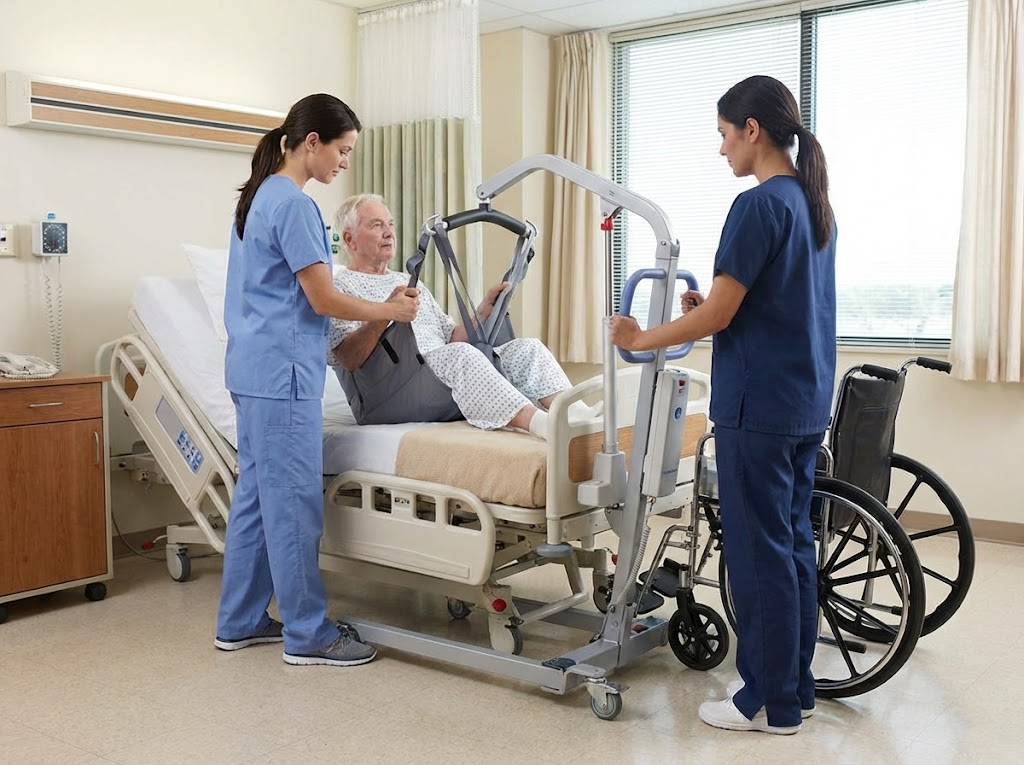
The Centers for Disease Control and Prevention identifies patient handling as the single greatest risk factor for musculoskeletal disorders among healthcare workers. The organization cites safe patient handling programs, lifting devices, and employer-side risk evaluation as prevention measures.
This is where many organizations hit a practical problem. The risks are known. However, the execution remains messy. Teams need a repeatable way to assess risk, assign the right actions, train staff, and track progress across departments.
The Ergonomics Risks Healthcare Workers Face Every Day
At Ergo Global, we see the numbers that show why healthcare ergonomics cannot be treated as a one-time workshop. Data from the Bureau of Labor Statistics in 2024 shows higher injury and illness incidence rates in healthcare and social assistance than in the private industry overall.
The total recordable case rates per 100 full-time workers show a clear divide:
- Private industry overall: 2.3
- Health care and social assistance: 3.4
- Hospitals: 5.1
- Nursing care facilities: 6.3
OSHA also highlights the severity of the issue in medical settings:
- Over 50 percent of injuries and illnesses reported among nursing assistants in 2020 were musculoskeletal disorders.
- United States hospitals recorded 7.6 work-related injuries and illnesses per 100 full-time employees in 2020. This compares with 2.7 per 100 across all industries nationwide.
- In 2017, nursing assistants had 18,090 cases with days away from work due to musculoskeletal disorders. That represents an incidence rate of 166.3 per 10,000 workers. The rate for all workers in similar cases was only 30.5 per 10,000.
Medical staff also report a high musculoskeletal burden over time. Industry research covering thousands of medical professionals shows an annual musculoskeletal disorder prevalence among nurses of over 77 percent. The most affected areas include:
- Lower back: 59.5 percent
- Neck: 53.0 percent
- Shoulder: 46.8 percent
Why Fixing Healthcare Ergonomics Is Often Slower Than It Should Be
We see many medical organizations rely heavily on training. The issue is that training alone often does not produce the results leaders expect.
Recent industry reviews highlight two main findings about current prevention methods:
- Standard technique training likely fails to prevent lower back pain in health professionals.
- Physical interventions based solely on technique training rarely impact daily working practices or injury rates.
Experts agree that risk assessment strategies must be built directly into prevention efforts. Multi-part interventions based on a solid risk assessment program are much more likely to reduce patient-handling risk factors.
This is the operational gap that healthcare ergonomics software can close. A platform turns physical safety from isolated training sessions into a managed workflow. Risk assessment, corrective actions, education, and reporting are integrated into a single process.
How Ergonomics Software for Healthcare Works in Practice
A useful healthcare ergonomics platform should do more than collect forms. It should support the full cycle from risk identification to corrective action.
We designed ErgoWOW as an AI-ergonomics software platform to manage and automate this entire cycle. Teams ranging from 300 to 80,000 employees use our system. The platform functions as a one-stop system for assessments, equipment, education, and program oversight.
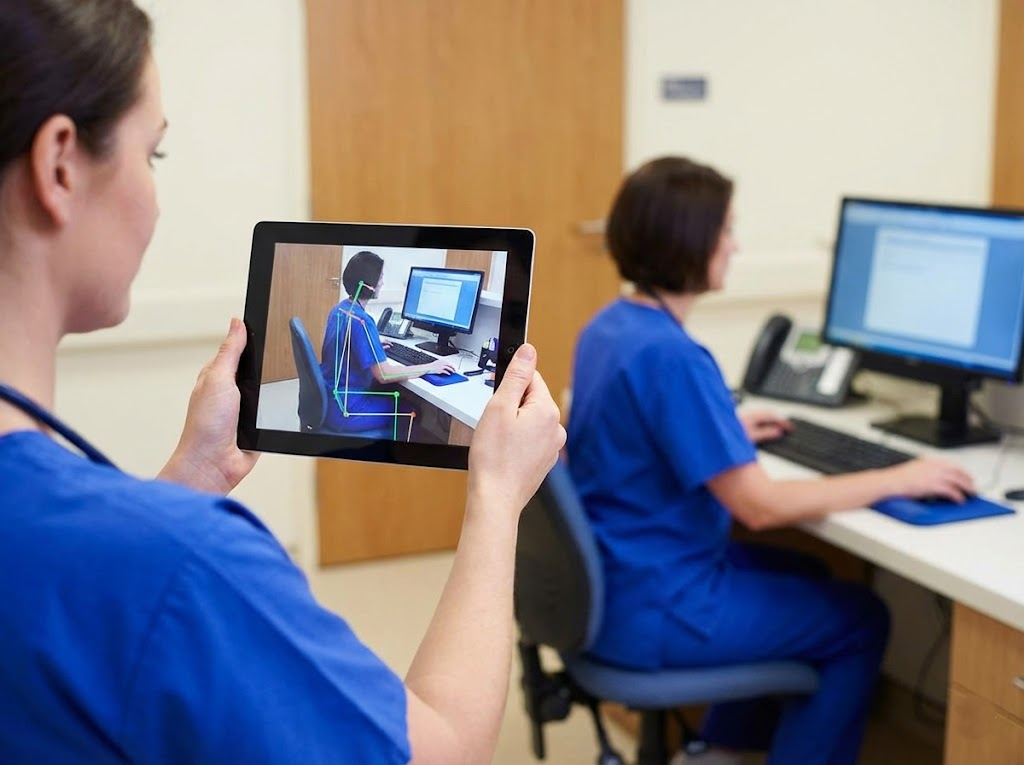
1. Staff Complete Guided Ergonomic Assessments
Our ErgoWOW platform features an assessment flow where each employee submits a photo or video of themselves working. They then complete a guided interaction about their daily routine.
This is a practical fit for clinical settings because different roles can be assessed without waiting for every review to be done live on site. You can segment assessments by role or job type. This approach maps directly to:
- Clinical staff
- Laboratory teams
- Imaging departments
- Administrative staff
- Telehealth workers
- Facilities teams
2. The Platform Links Risk Findings to Equipment and Follow-Up
Our workflow includes equipment recommendations right after the assessment. Employees see an equipment list and guidance based on your specific company policy.
For medical employers, that step matters heavily. Risk reduction often depends on getting the right equipment into the right area. You must also track what was recommended versus what was actually implemented. Flagged assessments trigger alerts, so follow-up actions can be assigned directly from the dashboard. That helps safety managers, human resources, occupational health, and department leaders move from visibility to action without having to open separate spreadsheets.
3. Staff Receive Education Inside the Same Workflow
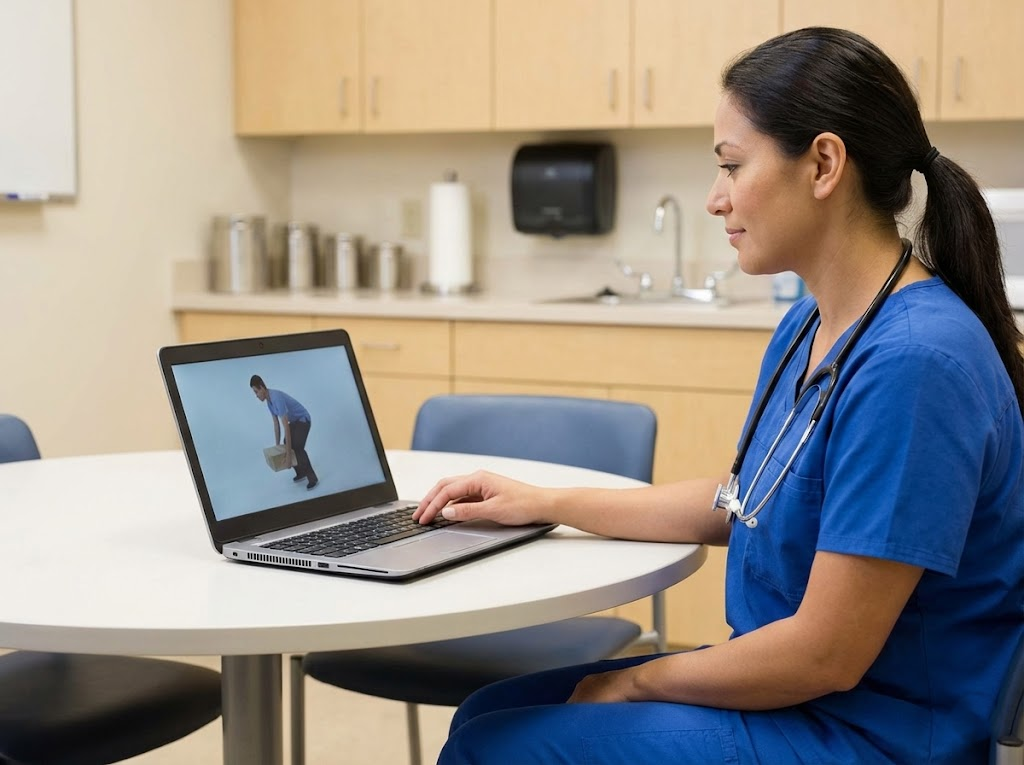
We built ErgoWOW to provide educational content, including videos, infographics, quizzes, and embedded awareness modules with posture coaching.
This matters heavily in medical facilities. Prevention improves when staff can learn in context, right after a risk is identified, instead of weeks later in a generic session.
4. Management Gets Reporting for Safety and Compliance Decisions
Our platform presents management views for business, compliance, and reporting. You receive in-depth reporting and actionable recommendations directly from our professional ergonomists.
Managers gain real-time visibility into health scores, red flags, and compliance trends. Dashboard views let you sort data by geography, function, business unit, or health category. For medical systems with multiple sites, this is exactly where healthcare ergonomics software starts to save massive amounts of time. Teams can prioritize departments with repeated strain indicators, track unresolved risks, and review patterns before they become injury claims.
How ErgoWOW Speeds Up the Healthcare Ergonomics Process
We positioned ErgoWOW for program scale and operational use, not just isolated assessments. The platform is web-based and works in any browser. It effortlessly supports remote and hybrid staff.
Our software scales across multi-country teams in over 50 countries with more than 20 languages. We also support API integrations, single sign-on, and regional access control for enterprise use cases.
That matters in clinical settings where you may have hospital groups across regions, mixed worker populations, and strict data access rules. Different local compliance requirements also complicate matters. ErgoWOW aligns with international guidelines, including:
- ISO 45001
- OSHA regulations
- EU DSE directives
The platform also maintains full GDPR compliance and holds ISO/IEC 27001 accreditation.
Ergo Global and ErgoWOW for Healthcare Teams
At Ergo Global, we built ErgoWOW to help healthcare teams move faster from risk spotting to real action. Our ergonomists shaped workflows, AI assessments, and educational tools so that busy hospitals and clinics can run safety programs with less administrative overhead and clearer reporting.
We can configure the platform for your specific roles, policies, and compliance needs. Our senior ergonomists then support your rollout every step of the way. If you want a demo of our ergonomics software for healthcare, talk to us directly, and we will show you exactly how it fits your setting.
Talk to us today about a demo and a plan that fits your workforce configuration.