Understanding Your Legal Obligations Under Display Screen Equipment Regulations
DSE Assessment Requirements: Your Complete UK Compliance Guide
Understanding Your Legal Obligations Under Display Screen Equipment Regulations
If you’re responsible for health and safety compliance in a UK organisation, understanding DSE assessment requirements is non-negotiable. The Health and Safety (Display Screen Equipment) Regulations 1992 place clear legal duties on employers to assess workstations and reduce risks for anyone who uses display screen equipment as a significant part of their work. Whether you’re managing an office-based team, remote workers, or a hybrid workforce, these requirements apply to you—and the implementation challenges have only intensified since the shift to home working.
This guide addresses the practical reality facing HR managers and health and safety officers today: you need to demonstrate legal compliance across diverse working environments whilst managing limited resources and competing priorities. We’ll walk through exactly what the law requires, who needs assessments, how to approach office versus home working scenarios, and the implementation framework that makes compliance achievable rather than overwhelming.

What the Law Actually Requires: Breaking Down DSE Regulations
The Health and Safety (Display Screen Equipment) Regulations 1992 were designed to prevent musculoskeletal disorders, visual fatigue, and stress-related conditions among workers who regularly use computers or similar equipment. According to the Health and Safety Executive (HSE), the regulator responsible for enforcing these rules, employers must conduct suitable and sufficient assessments of all workstations used by their DSE users.
Here’s what “suitable and sufficient” actually means in practice:
- Identify all DSE users: Anyone who uses display screen equipment continuously for an hour or more at a time qualifies as a user under the regulations
- Assess each workstation: Evaluate the entire workstation setup including screen, keyboard, desk, chair, lighting, and working environment
- Reduce identified risks: Take action to address any problems discovered during assessment
- Provide information and training: Ensure users understand how to set up and use their workstation safely
- Review assessments regularly: Reassess when significant changes occur—new equipment, relocated staff, or changes in work patterns
The regulations also require employers to plan work activities so that DSE use is periodically interrupted by breaks or changes of activity, and to arrange eye tests for DSE users who request them, contributing to the cost of basic corrective appliances if the test shows these are needed specifically for DSE work.
Who Counts as a DSE User?
This is where many organisations underestimate their obligations. A DSE user isn’t just someone who works at a computer all day. The HSE defines users as those who depend on DSE to do their job, use DSE for continuous periods of an hour or more, and use DSE in this way more or less daily. This definition captures not only office administrators and data processors, but also designers, developers, customer service representatives, managers who spend significant time on email and reports, and increasingly, remote and hybrid workers who split their time between locations.
Crucially, the location where DSE work takes place doesn’t change the employer’s duty. Whether your employee works in a head office, regional branch, coworking space, or home office, if they’re a DSE user, you must assess their workstation and manage the risks.
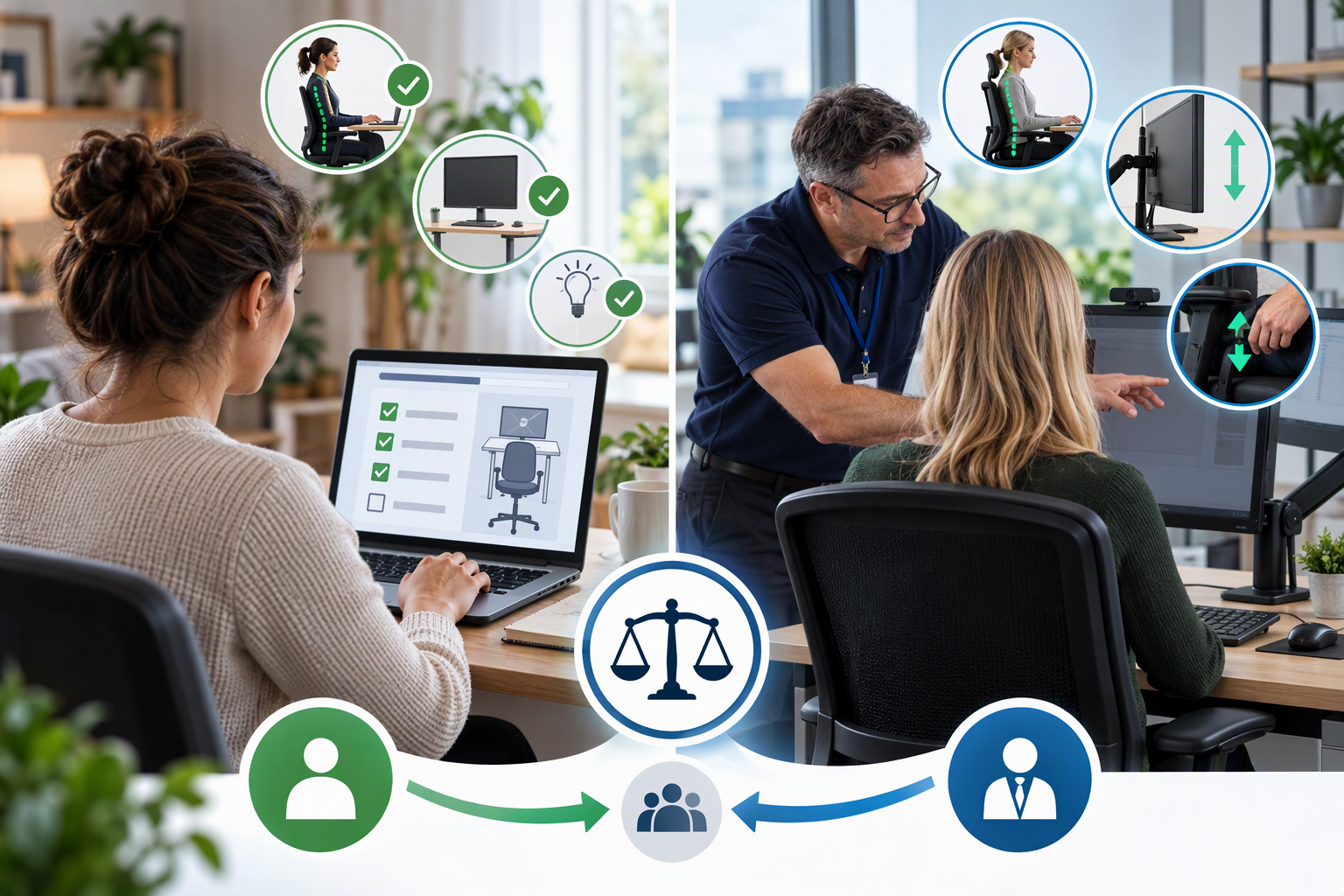
Office, Home and Hybrid Workers: Navigating Different Assessment Scenarios
The shift to widespread home and hybrid working has created one of the biggest practical challenges for compliance officers. The regulations were written when most DSE work happened in employer-controlled offices, but the legal duties haven’t changed—only the complexity of meeting them has increased.
Office-Based Workstation Assessments
Assessing office workstations remains the most straightforward scenario. You control the environment, equipment, and setup. A systematic approach typically involves an initial professional assessment to establish baseline standards, followed by training employees to complete self-assessments using a structured checklist. Because you control procurement and facilities, addressing identified issues—replacing inadequate chairs, improving lighting, providing footrests—can be coordinated centrally and implemented relatively quickly.
Home Working DSE Requirements
Home working introduces variables you can’t directly control but remain legally responsible for managing. Your employee might work from a kitchen table, bedroom, or dedicated home office. The furniture might be entirely unsuitable for prolonged DSE use. Lighting could be inadequate. Yet the assessment requirement remains unchanged. For detailed guidance on this specific challenge, see our comprehensive guide to DSE assessments for home workers.
The practical approach for home workers typically involves:
- Structured self-assessment: Providing a detailed assessment tool employees can complete themselves, with photographic evidence where possible
- Remote verification: Having a competent person review submitted assessments and photographic evidence, conducting video calls where concerns are identified
- Equipment provision: Establishing clear policies on what equipment will be provided (monitor, keyboard, mouse, chair) and the process for requesting items
- Budget allocation: Setting reasonable budgets for home office improvements and clear approval processes
- Ongoing support: Creating accessible channels for employees to raise concerns or request reassessment when circumstances change
Hybrid Working Complications
Hybrid workers present the most complex scenario: they’re DSE users in multiple locations, each of which requires assessment. An employee who works three days in the office and two at home needs both workstations assessed. If they also regularly work from client sites or coworking spaces, the complexity multiplies. The pragmatic approach focuses assessment effort where risk is highest—typically the location where most DSE work occurs—whilst ensuring minimum standards are met everywhere.
Common Compliance Pitfall
Many organisations assume that because an employee chooses to work from home, the employer’s responsibility diminishes. This is incorrect. The regulations make no distinction based on work location. Your duty to assess and reduce DSE-related risks applies wherever your employees perform their work.
Self-Assessment vs Professional Assessment: Making the Right Choice
One of the first implementation decisions you’ll face is whether to rely on employee self-assessment, commission professional assessments, or adopt a hybrid approach. There’s no single right answer—the appropriate choice depends on your organisation’s size, risk profile, resources, and workforce distribution.
When Self-Assessment Works
Self-assessment can be effective and legally compliant when properly structured and supported. It works best for:
- Straightforward office environments with standard equipment and layouts
- Organisations with limited budgets for external services
- Workforces with relatively low DSE-related risk factors (younger employees, no history of musculoskeletal problems)
- Situations where you have competent internal resources to design assessment tools, review results, and identify when professional input is needed
The key to successful self-assessment is structure and oversight. Employees need clear, comprehensive assessment checklists that guide them through every relevant factor, photographic examples of correct setup, and easy access to advice when they’re uncertain. Someone competent in DSE assessment must review every completed assessment and have authority to commission professional input when complex issues are identified.
When Professional Assessment Is Warranted
Professional DSE assessments become necessary or strongly advisable in several scenarios:
- Employees with existing musculoskeletal conditions or visual impairments
- Situations where self-assessment has identified problems but appropriate solutions aren’t clear
- High-risk roles involving prolonged, intensive DSE use
- Complex home working setups where suitable equipment or space is genuinely limited
- Following accidents or ill-health reports potentially related to DSE use
- When employees express discomfort or concern about their setup but can’t articulate specific problems
Professional assessors bring expertise in ergonomics, an objective perspective, and the ability to recommend specific solutions tailored to individual circumstances. For organisations managing significant home working populations, professional remote assessment services—conducted via video call—offer a middle ground between full on-site visits and unsupported self-assessment.

The Hybrid Model: Tiered Assessment
Many organisations find success with a tiered approach that matches assessment intensity to risk:
- Tier 1 – Standard self-assessment: All DSE users complete a structured self-assessment annually or when circumstances change
- Tier 2 – Enhanced review: Assessments flagging issues receive detailed review by a competent internal person (often a trained health and safety officer)
- Tier 3 – Professional assessment: Complex cases, employees with health concerns, or situations where Tier 2 review doesn’t resolve issues receive professional ergonomic assessment
This model focuses resources where risk and complexity are highest whilst maintaining legal compliance across your entire DSE user population.
Implementation Framework: From Policy to Practice
Understanding your legal obligations is one thing; implementing a compliant, sustainable DSE assessment programme across a distributed workforce is another. Here’s a practical framework that moves from policy development to ongoing operation.
Phase 1: Establish Your Policy and Scope (Weeks 1-2)
Begin by documenting exactly what your organisation will do to meet DSE requirements. Your DSE assessment policy should define who qualifies as a DSE user in your organisation, the assessment process they’ll follow, what equipment and adjustments will be provided, frequency of reassessment, and how employees request assessments or raise concerns. This policy needs board-level approval and should integrate with your broader health and safety policy.
Simultaneously, identify your DSE user population. In most modern organisations, this will be the majority of office-based and home-based employees. Don’t underestimate this group—include part-time workers, contractors who work on your premises or equipment, and anyone whose role involves regular, sustained computer use.
Phase 2: Develop Assessment Tools and Guidance (Weeks 3-4)
Create or procure comprehensive assessment checklists tailored to your workplace scenarios. You’ll likely need separate tools for office workstations, home working setups, and potentially specialist environments. Each checklist must systematically address all DSE assessment factors: screens and displays, keyboards and input devices, desks and work surfaces, seating, environment (lighting, glare, noise, temperature), and work organisation.
Accompany checklists with practical guidance: photographic examples of correct setup, instructions for adjusting common chair types, guidance on monitor positioning and height, advice on managing glare and lighting. The HSE provides useful baseline resources, but you’ll achieve better compliance by customising materials to reflect your actual equipment and environments.
Phase 3: Communication and Training (Weeks 5-6)
Before launching assessments, communicate clearly with employees about why this matters, what’s required of them, and what support is available. Address the common concern that assessments create work or lead to criticism—frame this as a health protection measure and legal obligation, not a test.
Train employees to complete self-assessments competently. This might be via online modules, live webinars, or written guides, but should include practical examples and the opportunity to ask questions. Also train managers and any internal staff who will review assessments or handle follow-up actions.
Phase 4: Conduct Initial Assessments (Weeks 7-12)
Roll out the assessment process systematically. For larger organisations, consider phasing by department or location to manage the volume of reviews and follow-up actions. Set clear deadlines, track completion rates, and send reminders to non-responders.
As assessments are completed, establish a triage process. Simple, compliant setups require only record-keeping. Issues that can be resolved with standard equipment provision (keyboard, mouse, monitor riser, footrest) should be addressed quickly through established procurement channels. Complex cases requiring professional input should be scheduled promptly.
Phase 5: Address Identified Issues (Weeks 8 onwards)
This is where policy meets budget. You’ll identify a range of required actions: equipment purchases, environmental changes (lighting, desk positions, screen filters), furniture replacement, and potentially specialist ergonomic equipment for employees with particular needs. Establish clear approval processes, budgets, and timescales. Delays undermine the entire programme and potentially leave you non-compliant despite having conducted assessments.
Phase 6: Ongoing Review and Reassessment (Continuous)
DSE assessment isn’t a one-time project; it’s an ongoing compliance requirement. Build reassessment into your HR and health and safety processes: trigger assessments for new starters, employees changing role or location, following absence due to musculoskeletal problems, when new equipment is introduced, and routinely (at least every two years for stable situations). Maintain accessible channels for employees to request ad-hoc reassessment when circumstances change or problems develop.
Need Expert Support With DSE Compliance?
Managing DSE assessment requirements across office, home and hybrid workers requires expertise, resources and time. Our professional DSE workstation assessment service takes the complexity out of compliance, providing thorough assessments, clear recommendations, and documentation that demonstrates your legal obligations are met.
Industry-Specific Considerations and Common Scenarios
Whilst DSE regulations apply universally, practical implementation varies considerably by industry and work pattern. Understanding how DSE requirements apply to your specific context helps focus effort appropriately.
Call Centres and Customer Service Environments
High-intensity, prolonged DSE use combined with constrained postures (headset use, frequent typing) creates elevated risk. Assessment must pay particular attention to workstation adjustability, equipment quality, and work organisation. Scheduled breaks become especially important, as does ensuring headsets are correctly fitted and adjusted. Many call centre environments