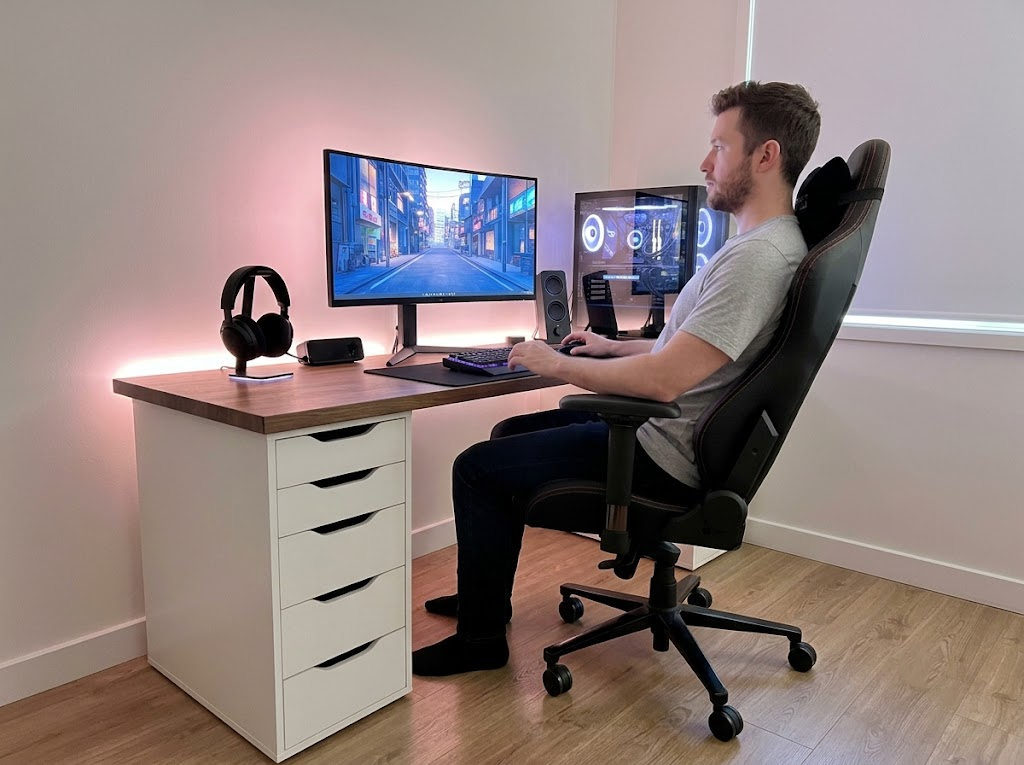


Your spine is not passive. It is a living, load-bearing structure that responds continuously to the positions and pressures it experiences. Every hour at a desk, every degree of slouch, and every year of a sedentary career leave a mark on the vertebrae, discs, and surrounding tissues. The good news is that office ergonomics for spine health gives us a precise set of tools to change those inputs and steer the outcome.
Low back pain has ranked as the world’s leading cause of disability for over three decades, and the office environment is one of the most consistent contributors to that burden. This article explains what is actually happening inside your spine during a typical workday, why those changes matter over time, and how purposeful ergonomic design changes the trajectory.
Your Disc Under Pressure: What Sitting Really Does
Most people understand that prolonged sitting is bad for the back. Few understand exactly why. The answer lies in the intervertebral disc, the shock-absorbing structure between each pair of vertebrae.

Discs have no direct blood supply. They rely on a process called imbibition to stay hydrated and nourished: fluid and nutrients are absorbed when pressure on the disc is reduced, and waste products are expelled when pressure increases. Movement throughout the day drives this exchange. Static sitting interrupts it, and research tracking spinal height over a working day has found that people lose roughly 1% of their standing height by the end of the day as fluid is progressively squeezed out of the lumbar discs.
When you sit, particularly in a slumped or unsupported posture, several things happen simultaneously:
- The lumbar spine loses its natural inward curve, shifting disc loading from a distributed, even pattern to a concentrated forward load
- The posterior disc wall experiences increased tension, which, over time, can lead to annular tears and eventual herniation
- Sustained compression slows the imbibition cycle, gradually dehydrating disc tissue and reducing its load-bearing capacity
- Surrounding muscles fatigue and reduce their supportive contribution, transferring more force directly to the passive spinal structures
Research measuring pressure inside the lumbar disc has found that sitting generates 20 to 40% higher intradiscal loads than standing, and that figure climbs substantially in a forward-flexed, unsupported posture.
This is not a problem that announces itself loudly on any given day. It is a slow accumulation that builds quietly over months and years.
How Spinal Problems Actually Develop
Spinal conditions rarely arrive without warning. They are the end result of mechanical stress applied repeatedly to tissues that were never given sufficient time or support to recover.
Think of the spine like any structure under cyclic loading. A single heavy load does not always cause failure. Thousands of smaller loads, applied again and again to the same structural weakness, eventually do. The human spine was not designed for sustained sitting, and prolonged sedentary posture places approximately 40% more pressure on the lumbar discs than standing upright.
Office workers experience exactly this pattern: the same spinal position held for the same hours each day, the same muscle fatigue setting in at the same time each afternoon, and the same insufficient recovery before it begins the next morning again.
Studies estimate that between 25 and 40% of office workers report persistent lower back pain, and one-year prevalence rates for neck pain among sedentary office workers range from 42 to 69%. These are not accidents or bad luck. They are predictable outcomes of workplaces that have not been designed with the spine in mind.
Understanding this cumulative model reframes the purpose of office ergonomics for spine health. The goal is not to find a perfectly comfortable chair. It is to systematically reduce spinal loading throughout every hour of every working day, so the accumulation never reaches the threshold at which tissues fail.
How Ergonomics Changes Spinal Physics

Every adjustment you make to your workstation either increases or decreases the mechanical load on specific spinal structures. Understanding the mechanism makes each change feel purposeful rather than arbitrary.
Restoring the Lumbar Curve
The lumbar spine’s natural inward curve, its lordosis, is the position in which disc loading is most evenly distributed across the disc’s cross-section. When that curve flattens in a slumped seat, load concentrates at the disc’s front edge and tension builds at the back. Lumbar support that preserves the lordosis restores even load distribution and reduces stress on the posterior disc wall, which is where the majority of desk-related disc injuries originate.
The support should sit in the hollow of the lower back, not at the mid-back. Its purpose is to prevent the pelvis from rotating backward, which is the root cause of lumbar flattening in the seated position. Without pelvic support, even the most expensive chair cannot maintain the curve that protects the disc.
Reducing Cervical Load
Every degree the head tilts forward from its balanced neutral position adds disproportionate load to the cervical vertebrae below it. An adult head weighs 10 to 12 pounds in neutral alignment. At a thirty-degree forward tilt, the load on the cervical spine rises to roughly 40 pounds, and at sixty degrees it reaches 60 pounds. Screen height is the primary control point for this variable.
A monitor positioned with the top of the screen at or slightly below eye level, roughly at arm’s length away, keeps the head in neutral alignment over the shoulders. This single adjustment addresses one of the most common drivers of cervical disc stress and upper trapezius overload in office workers.
Desk Height and Thoracic Loading
A desk set at the wrong height forces the shoulder girdle into a sustained elevated or depressed position, transmitting tension downward through the thoracic spine and upward into the neck. The forearms should rest at roughly a ninety-degree elbow angle with the shoulders relaxed and level.
When the desk is too high and the shoulders shrug to compensate, the thoracic and cervical muscles work continuously to stabilize a position they were not designed to hold for hours on end.
Six Body-Based Checks for a Spine-Protective Seated Position
Knowing the principles of spinal loading is one thing. Translating them into a correctly fitted seat is another. These six sequential checks give you a physical method for dialing in your seated posture, starting from your elbows and working outward to the full workstation.
1. Elbow Check
Sit as close to your desk as comfortable with your upper arms hanging naturally at your sides. Rest your hands on the work surface. Your elbows should form roughly a ninety-degree angle. If they are lower than that, raise the chair. If higher, lower it. Getting this right first makes every subsequent adjustment easier.

2. Thigh Check
With your feet flat on the floor, try to slide your fingers beneath your thigh at the front edge of the seat. Your fingers should pass through with light resistance. If the space is too tight, your circulation is being restricted and you need a footrest to raise your feet slightly. If there is more than a finger’s width of clearance, the desk needs to come up so you can raise the chair accordingly.
3. Calf Check
Sit fully back in the chair with your buttocks against the backrest. Try to pass a clenched fist between the back of your calf and the front of the seat edge. If you cannot do this comfortably, the seat is too deep for your leg length. Adjust the backrest forward, add a lumbar cushion to reduce seat depth, or consider a different chair.
4. Lower Back Check
Your buttocks should maintain contact with the back of the chair throughout the working day. The lumbar support should create a gentle inward arch in your lower back, enough to prevent you from gradually rounding forward as fatigue sets in. This is the adjustment that does the most work for spinal disc health over the course of a sitting session. Allowing yourself to slump forward shifts the entire spinal load toward the disc’s weaker posterior wall.
5. Eye Level Check
Close your eyes while sitting in your natural resting position. Open them. Your gaze should land at the top of your screen. If the screen is above or below that point, adjust it until it meets your natural gaze line. Bifocal wearers should lower the screen enough to read without tilting the head back, or switch to full-lens near-vision glasses for desk work.

6. Armrest Check
Raise the armrests until they just barely lift the weight of your arms at the shoulders. This small offload takes meaningful strain off the neck and upper trapezius throughout the day and reduces the tendency to lean forward. Armrests set too high elevate the shoulders and create tension. Set too low, they offer no benefit.
A Note on Alternative Seating
Some people find that active seating, such as a kneeling chair or an exercise ball, suits their working style. A kneeling chair promotes a natural lumbar curve without a backrest, and an exercise ball encourages subtle postural adjustments that engage the core and back muscles.
Both can be useful for short periods or as complements to a standard chair. If you have a pre-existing spinal condition or injury, consult a health professional before making your primary work seat.
The Muscle Equation: Why Ergonomics Alone Is Not Enough
A well-adjusted workstation reduces external load on the spine. Conditioned muscles reduce internal load by sharing the work that would otherwise fall on the passive structures: the discs, ligaments, and facet joints. Office ergonomics for spine health works best when it is paired with a deliberate conditioning approach.
The muscles most relevant here are not the obvious ones. The deep spinal stabilizers, particularly the multifidus and the transversus abdominis, operate at low activation levels throughout the day to maintain spinal position.
When these muscles are deconditioned from years of sitting, they fatigue earlier, hand the job to superficial muscles that are not designed for prolonged postural work, and eventually disengage entirely. The result is a spine relying almost entirely on its passive structures for support by mid-afternoon.
A short, consistent routine targeting these specific muscles does more for long-term spine health than occasional intense training:
Bird Dog
On hands and knees, extend one arm and the opposite leg, hold for three seconds, then switch. This directly activates the multifidus along the full length of the lumbar spine. Three sets of eight repetitions per side.
Dead Bug
Lying on your back, lower one arm overhead and the opposite leg toward the floor simultaneously while keeping the lower back flat against the ground, then return and switch. This builds anterior support that counterbalances lumbar loading during long periods of sitting. Ten repetitions on each side.
Pallof Press
With a resistance band fixed at chest height, stand sideways to it and press both hands straight forward, holding for three seconds before returning. This trains the deep stabilizers to resist rotation, which is the most common force applied to the lumbar spine during seated asymmetrical work. Ten repetitions on each side.
Movement as Disc Medicine
Movement is not simply a comfort measure. It is biologically necessary for disc health. The imbibition cycle that keeps discs nourished depends on regular alternation between spinal loading and unloading throughout the day.
When that cycle stalls under sustained static sitting, the disc loses height and resilience over time. Research tracking spinal disc hydration via MRI has found that it begins to decline measurably after approximately 50 minutes of continuous sitting, regardless of chair type, and that standing or walking for just two to three minutes is enough to restart the imbibition cycle.

Sedentary behavior has been identified as a significant risk factor for low back pain in office workers, with the proposed mechanism running directly through disc nutrition: reduced movement slows fluid exchange, contributes to degenerative changes, and progressively compromises disc integrity.
The practical implication is straightforward. Breaking seated posture every 30 minutes, walking during calls, taking a genuine midday break away from the desk, and incorporating brief in-seat spinal mobilizations throughout the day all serve the disc’s biological needs in ways that no static posture, however well-supported, can replicate. These are not optional wellness add-ons. They are mechanically necessary components of office ergonomics for spine health.
Recognizing the Early Signals
Office-related spinal problems tend to present differently depending on which region is carrying the greatest load. Catching these patterns early matters because early-stage spinal strain responds well to ergonomic correction and conditioning. Late-stage pathology is far more disruptive and costly to address.
| Spinal Region | Early Warning Signs | Symptoms That Need Prompt Attention |
| Cervical (neck) | Stiffness after screen sessions, base-of-skull headaches, upper shoulder tightness | Tingling or numbness in the arms or hands, persistent pain after sleep |
| Thoracic (mid-back) | Stiffness between the shoulder blades, reduced rotation, shallow breathing | Sharp pain with deep breathing, an ache that does not respond to movement |
| Lumbar (lower back) | End-of-day fatigue in the lower back, morning stiffness, hip flexor tightness | Pain radiating below the knee, leg weakness, any change in bladder or bowel function |
The symptoms in the right column warrant professional assessment without delay. Everything in the middle column is a signal that the workstation and movement habits need attention now, before the picture worsens.
Treating Ergonomics as an Ongoing Practice
A one-time workstation adjustment is a starting point, not a destination. People change desks, work from different locations, shift between equipment, and experience physical changes through injury, aging, and varying job demands. Each of these shifts alters what a properly fitted workspace looks like.
The organizations that see sustained reductions in spinal injury rates are those that treat office ergonomics for spine health as an active, recurring practice. They schedule periodic workstation reviews, train employees to recognize early strain signals, make it easy to request adjustments, and build movement into the culture of the workday rather than treating it as a distraction from work.
The spine rewards consistency. Small, well-chosen changes maintained over time produce far better outcomes than dramatic interventions applied occasionally.
How Ergo Global Can Help
At Ergo Global, office ergonomics for spine health is our area of expertise. We work directly with businesses and individuals to assess workstations, identify the specific loading patterns putting spines at risk, and design targeted interventions that address root causes.
Our consultants bring a deep understanding of spinal biomechanics to every engagement, combining practical workstation improvements with staff education that makes the changes last. We have helped organizations across industries reduce spinal injury rates, lower absenteeism, and give their teams the physical foundation to perform at their best, day after day.
Contact us today to book a consultation and start protecting your team’s spine.